Answer: Aluminum marine gas tanks offer lightweight durability, corrosion resistance, and easy maintenance for boats, pontoons, and river craft. This guide highlights five aluminum fuel cells that suit different boat sizes, fuel needs, and installation styles. Best for speed boats and drift cars is the universal 15-gallon Parts-Diyer unit; best for pontoons and larger boats is the 25-gallon Moeller option; best for compact storage is the 12-gallon DNA Motoring unit; best for versatile fuel lines is the EVIL ENERGY 15-gallon tank; and best overall value for mixed-use boats is the RDS MFG 13-gallon tank. The table below summarizes key specs to compare at a glance.
| Product | Capacity | Material | Best For | Notes |
|---|---|---|---|---|
| Parts-Diyer Blue 15G Aluminum Fuel Cell | 15 gal / 57 L | Aluminum | Racing, street drift, and small to mid-size boats | 0-90 Ohm sender; 8 AN rollover vent |
| Parts-Diyer White 15G Aluminum Fuel Cell | 15 gal / 57 L | Aluminum | Same footprint as blue variant; versatile wrap | 0-90 Ohm sender; high-quality cap |
| EVIL ENERGY 15G Aluminum Fuel Cell | 15 gal / 57 L | Aluminum | Versatile fuel lines; street drift and marine use | Includes 3–90 ohm level sensor; not for E85 with certain lines |
| DNA Motoring 12G Aluminum Tank | 12 gal / 45 L | Aluminum | Compact boats and external fuel pumps | 8 AN fuel pickup; external pumps only |
| RDS MFG 13-Gallon General-Purpose Tank | 13 gal | Aluminum | General marine fueling on varied hulls | Top-based gasoline fueling; swing arm sender |
Parts-Diyer Blue 15G Aluminum Fuel Cell

The Parts-Diyer blue 15-gallon aluminum fuel cell is designed for space-conscious installations on mid-sized boats or drift racing setups. It features a 30″ L x 12″ W x 9″ H footprint and a 0-90 ohm fuel sender for compatible fuel gauges. The 8 AN rollover vent helps prevent splash and venting during hard turns. Best for: small to mid-size boats needing a compact, lightweight tank with a level sensor. Limitation: the max capacity is 15 gallons, which may require refueling more often on longer trips or high-consumption engines.
Parts-Diyer White 15G Aluminum Fuel Cell

This white variants mirrors the blue model with identical internal components and a 53L capacity. It uses a 1.75″ filler neck cap and high-grade aluminum for corrosion resistance, keeping the fuel clean over time. Best for: boat owners who want a reliable, mid-range capacity tank with a robust build. Limitation: like other aluminum tanks, installation requires proper mounting to avoid vibration and wear over time.
EVIL ENERGY 15 Gallon Fuel Cell
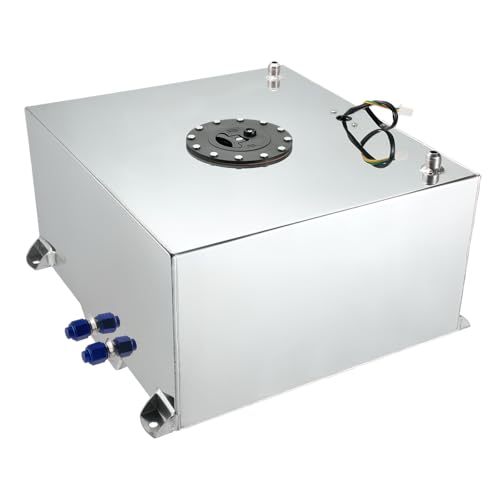
The EVIL ENERGY 15-gallon aluminum fuel cell includes an integrated 3–90 ohm level sensor and anti-slosh foam, offering stable fuel readings during boating vibrations. It supports a broad range of fuels, including diesel in some configurations, and uses a 10AN inlet/outlet. Best for: users needing a sensor-enabled tank with solid corrosion resistance. Caution: not recommended for E85 gasoline or certain methanol blends when used with incompatible fuel lines.
DNA Motoring 12 Gallons Aluminum Tank

The DNA Motoring ALU-FT-B-TF-12G-BK tank offers an 18″ L x 12″ W x 12″ H footprint with a top-feed design and 8 AN fuel pickup. It is intended for use with external fuel pumps only. Best for: smaller boats or applications where an external pump is already installed. Limitation: not suitable for internal fuel pump configurations or integral engine supply without modification.
RDS MFG INC 13-Gallon General-Purpose Tank

The RDS MFG 13-gallon tank is positioned as a general-purpose marine fuel tank with a rectangle shape that fits various hulls. It supports top-fueling and uses a swing-arm sender for easy gauge connections. Best for: boats needing a mid-capacity, versatile tank with standard fittings. Limitation: specific fuel compatibility and component options depend on installation and line routing.
Buying Guide: Key Considerations for Aluminum Marine Tanks
What capacity fits your boat and fuel consumption?
Choose capacity based on typical trip length, engine fuel economy, and refueling opportunities. Higher capacity reduces refueling frequency but adds weight and space requirements.
How to assess fit and mounting?
Measure available hull space and mounting points. Look for tanks with standardized fittings (e.g., 8 AN, 10 AN) and compatible level senders for your gauge system. Vibration-resistant mounting reduces wear over time.
Is a level sensor important?
Tanks with built-in 0-90 ohm sensors provide direct readings to most gauges. If your system uses a different standard, verify sender compatibility before purchase.
What about materials and corrosion resistance?
Aluminum tanks offer light weight and corrosion resistance in saltwater environments. Ensure all fittings, caps, and vent components are also aluminum or corrosion-protected to extend life.
Do you need a venting and filler setup?
Rollover vents and proper filler necks help prevent spills and venting. Ensure the tank includes compatible venting hardware and a secure cap to minimize leaks during boating activity.
Which tank is best for external pumps?
Tanks designed for external fuel pumps typically have top-feed configurations and a robust pickup. If your engine uses an inline pump, verify the tank’s outlet size and routing options before buying.
FAQ
- What capacity aluminum marine tank should I choose for a small runabout? A 12–15 gallon tank is commonly suitable for smaller runabouts with moderate fuel usage.
- Are aluminum tanks safe for saltwater boats? Yes. Aluminum provides corrosion resistance when properly vented and sealed, and fittings should be corrosion-protected.
- Do these tanks come with level sensors? Some models include 0-90 ohm level sensors; verify sensor compatibility in the product description.
- Can I use these tanks with diesel or ethanol blends? Some models support diesel or ethanol blends, but check the manufacturer’s guidance for each tank and your fuel system.
- Is a larger tank always better? Not necessarily. Balance capacity with weight, space, and fuel efficiency for your specific vessel and planned trips.
- What maintenance is required? Regularly inspect fittings, caps, vents, and level sensors for leaks and corrosion; clean the interior as needed per your fuel type.