Top choices for marine lower unit oil provide protection against wear, corrosion, and water intrusion while accommodating different gear ratios and boat speeds. This guide highlights five reliable options, explains who each product is best for, and notes practical cautions. Use these selections to help select the right oil for your outboard or sterndrive. The following table summarizes the featured products to compare at a glance.
| Product | Brand | Best For | Key Benefit |
|---|---|---|---|
| Quicksilver SAE 90 High Performance Gear Lube for Outboards and Sterndrives | Quicksilver | Mid- to high-hp outboards and sterndrives | Extreme pressure synthetic additives for metal-to-metal protection |
| Yamaha Yamalube Marine Lower Unit Gearcase Lube | Yamaha Motor | Long-term corrosion and rust protection | High-quality inhibitors for fresh and saltwater environments |
| Quicksilver 80W-90 Premium Gear Lube | Quicksilver | Mercury/Mercury-compatible gearcases | Direct replacement with wear and corrosion protection |
| Lucas Oil 10652 Synthetic SAW 75W-90 M8 Marine Gear Oil | Lucas Oil | General marine gear applications | Specialized synthetic formulation for marine service |
| STAR BRITE Star Tron Hypoid 90W Lower Unit Gear Lube | STAR BRITE | Broad compatibility across major brands | Advanced protection and broad brand compatibility |
Quicksilver SAE 90 High Performance Gear Lube for Outboards and Sterndrives

Best for mid- to high-horsepower outboards and sterndrives that operate above typical load ranges. This gear oil is designed to protect against corrosion and excessive wear in demanding marine environments. It uses extreme pressure synthetic additives to guard gears from metal-to-metal contact, extending gear life under heavy use. Choose this if you run larger engines or operate in challenging conditions where wear protection matters most. Caution: verify compatibility with your specific lower unit model and oil capacity requirements.
Quicksilver by Mercury Marine 80W-90 Premium Gear Lube
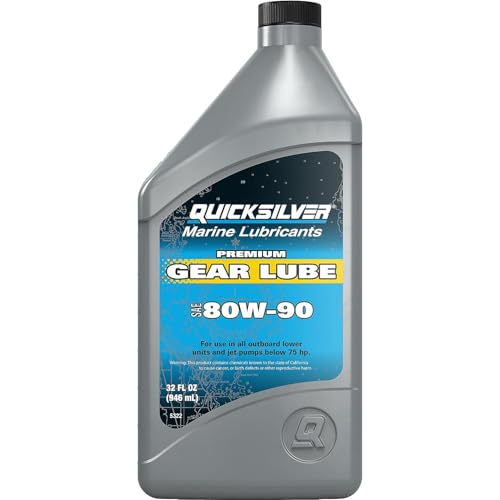
This option is a direct replacement for Mercury Marine gear cases and is designed to maximize protection against excessive wear, corrosion, and pitting. It is suitable for extended gear life in marine settings and includes additives to guard gears if water enters the gear case. Best for Mercury/Quicksilver owners seeking reliable, brand-aligned lubrication. Limitation: ensure your system’s viscosity requirements align with 80W-90 specs for your gear ratio and climate.
Yamaha Yamalube Marine Lower Unit Gearcase Lube

Best for anglers and boaters who demand robust protection under high-speed, long-run conditions. Yamaha’s Yamalube lower-unit lubricant is formulated to shield gear components from extreme pressures and prevent rust and corrosion in fresh and saltwater environments. It meets SAE 90/80W-90 and GL-4 requirements, ensuring compatibility with multiple gearcase designs. Choose this if you fish in saltwater or operate in hot climates where sustained protection is critical. Caution: confirm viscosity compatibility with older gearboxes before use.
Quicksilver SAE 90 High Performance Gear Lube and Pump Kit

This kit combines a 32 oz bottle of SAE 90 gear oil with a convenient pump, making it easier to service the lower unit of Mercury outboards and Mercruiser sterndrives above 75hp. It’s best for DIYers who want a ready-to-use solution with a built-in pump. A possible limitation is that it is tailored to certain engine configurations; verify your lower unit’s fill requirements and pump compatibility before purchasing.
Buying Guide: Marine Lower Unit Oil Essentials
What should I look for in marine lower unit oil?
keys include viscosity (SAE 90 or 80W-90 typically), compatibility with your gearcase design, and corrosion protection additives. Marine gear oils are designed to withstand water intrusion, pressure, and high-speed operation without breaking down easily.
Do I choose 90 vs 80W-90?
80W-90 offers better performance in very hot climates or where a lighter viscosity improves shifting, while SAE 90 provides robust protection in standard marine conditions. Check your engine manual for recommended viscosity.
Is brand matter important?
Brand-aligned lubricants (for example, Yamaha with Yamaha gear cases) can offer optimized compatibility. However, many non-branded or universal marine oils meet GL-4/GL-5 requirements and can work across brands. Always verify compatibility with your model.
Should I consider a gear oil pump kit?
A pump kit simplifies routine changes, reduces mess, and helps reach tall gear oil bottles. It is most useful for DIYers who perform frequent changes or service boats with hard-to-reach fill ports. Ensure the kit’s adapters fit your drain plugs and bottle necks.
What about multi-brand compatibility?
Some oils list broad brand compatibility, which is convenient for mixed fleets or fleets with different engines. If you own multiple brands (Mercury, Yamaha, etc.), select an oil noted as compatible with your engines or consult the manual.
How often should I service the lower unit?
Typical intervals depend on use and water exposure. In saltwater or heavy use, more frequent changes are prudent. Follow the boat manufacturer’s guidelines and inspect for water intrusion, metal debris, or unusual color during changes.
FAQ
- Q: Can I mix different brands of lower unit oil? A: Mixing is generally not recommended. Use the same viscosity and compatible oil when servicing a lower unit unless a manual permits mixing under specific guidelines.
- Q: Is water in the lower unit oil a sign of failure? A: Water intrusion can indicate a seal or vent issue. If water is present, inspect seals and perform a thorough oil change.
- Q: What viscosity is best for hot climates? A: In hotter climates, a slightly thicker oil (like SAE 90 or 80W-90) can help maintain lubrication under high temperatures.
- Q: Do I need a specific brand for my engine? A: Check the engine manual for viscosity and specification recommendations. Brand-specific oils can offer optimized performance for certain gearboxes.
- Q: Can I use automotive gear oil in a marine lower unit? A: Marine gear oils are formulated for water exposure and marine conditions; automotive oils may not provide the same protection against water intrusion and corrosion.
- Q: How do I know if the oil change is complete? A: After filling, check the level with the dipstick or fill plug per the manual and run the engine briefly to distribute oil, then recheck for proper level.