Answers to common buyer questions: which portable gas tanks are best for outboard engines, how much capacity you need, and what features matter most for saltwater use. This guide highlights top options for anglers, boaters, and deck setups. Each pick is chosen for compatibility, durability, and practical design to keep fuel secure and accessible on board.
The following table summarizes five top picks, including capacity, notable features, and ideal use cases.
| Product | |||
|---|---|---|---|
| VEVOR Boat Fuel Tank | 3.17 gal / 12 L | 9.8 ft hose, HDPE durability, 0.24″ hose inner diameter, 3 m hose length, compatible with Yamaha connectors | |
| AloneGoer 3 Gallon Portable Tank | 3 gal / 12 L | HDPE with EVOH barrier, UV stabilization, corrosion-resistant; includes connector hose | |
| Scepter 9 Gallon Portable Marine Gas Can | 9 gal / 34 L | 2-way vented cap, built-in fuel gauge, compatible with diesel and ethanol fuels | |
| VEVOR Marine Tank 6.34 Gallon | 6.34 gal / 24 L | 9.8 ft hose, gauge, anti-aging HDPE, spill-prevention inlet/outlet | |
| DEF Portable Boat Fuel Tank | 6 gal / ~24 L | Two seal/vent modes, oil volume indicator, built-in filter |
VEVOR Boat Fuel Tank 3.17 Gal With Hose

Best for small boats and deck setups needing a compact reserve. The 3.17-gallon capacity suits modest travel distances and quick fuel transfers. The 9.8-foot hose with a 0.24-inch inner diameter supports Yamaha connectors, making it a convenient match for common outboard motors. The tank is made of high-density polyethylene to resist aging and corrosion. A note: extended direct sunlight exposure should be avoided to minimize aging and expansion risks.
Best for: anglers on dinghies or small fishing boats, or as a secure under-seat fuel option on a deck boat. Limitation: smaller capacity means more frequent refueling on longer trips.
AloneGoer 3 Gallon Portable Tank
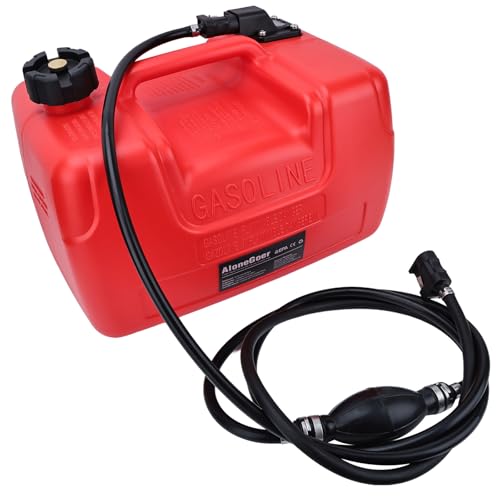
This 12L tank uses multi-layer HDPE-EVOH-HDPE construction to reduce fuel permeation and evaporation by up to 98%. It’s UV-stabilized and salt spray resistant, making it well-suited for saltwater environments. It includes a Yamaha-compatible connector and is designed as a reliable on-board spare or primary transfer tank for small to mid-size boats.
Best for: boaters needing low-evaporation performance and corrosion resistance. Limitation: not the largest capacity for long voyages without refilling.
Scepter 9 Gallon Portable Marine Gas Can

Designed for longer trips, this 9-gallon tank offers extended running time while keeping a compact footprint. It features a 2-way vented cap to manage vapor pressure during refueling and a built-in fuel gauge for quick checks. It supports diesel and ethanol-blended fuels, expanding fuel compatibility for various engines.
Best for: boaters needing more fuel without sacrificing space. Limitation: fuel line must be purchased separately and compatibility with certain fittings should be verified before use.
Scepter 6 Gallon Portable Marine Gas Can

This 6-gallon design balances capacity and portability, with a 2-way vented cap to prevent vapor buildup and a built-in gauge for quick fuel checks. It’s slim enough for under-seat storage and accepts standard 1/4 NPT marine fittings. It’s compatible with diesel and ethanol-containing fuels.
Best for: boats needing a mid-range option with under-seat storage. Limitation: may require more frequent refills on longer trips than larger tanks.
VEVOR Marine Tank 6.34 Gallon

Large enough for longer trips while still portable, this 6.34-gallon tank includes a 9.8-foot hose and a dedicated gauge. The separate inlet and outlet help prevent spills, and the HDPE shell resists aging and corrosion in marine environments. Avoid prolonged direct sunlight to reduce aging and expansion risk.
Best for: medium-sized boats needing increased fuel capacity without a heavy unit. Limitation: maintenance of hose alignment and gauge visibility is important for accurate readings.
DEF Portable Boat Fuel Tank 6 Gal

Six gallons of capacity with anti-aging HDPE and a dual sealing/venting cap design supports controlled fueling and reduces leakage. An oil volume indicator helps track remaining fuel, and an onboard filter guards against impurities entering the tank. The design supports safe, on-deck fuel transfers in varied conditions.
Best for: environments where fuel visibility and filter protection matter. Limitation: dual cap system may require careful handling during fast fueling to avoid mis-sealing.
Buying Guide: Key Considerations For Marine Outboard Gas Tanks
Capacity needs depend on boat size, engine type, and typical trip length. Smaller boats benefit from 3–4 gallon tanks for quick refuels, while larger vessels may require 6–9 gallons or more for extended outings.
Fuel compatibility and hose fittings are essential. Check hose length, inner diameter, and connector types to ensure compatibility with your outboard motor and fuel system.
Durability matters in saltwater: UV resistance, corrosion protection, and barrier layers reduce evaporation and aging. HDPE with EVOH barriers often offers strong performance.
Safety features include vented caps, pressure relief, built-in gauges, and spill-prevention inlets/outlets. Vented caps prevent dangerous vapor buildup during refueling.
Portability and storage: consider under-seat fit, handle design, and whether the tank can be stored securely when not in use. Slim profiles help with deck organization.
FAQ
- What capacity should I choose for a typical 20-foot boat? A 6–9 gallon tank is common for longer trips without frequent refueling, depending on engine efficiency and cruising speed.
- Are these tanks compatible with all fuel types? Most are compatible with diesel and ethanol-blended fuels, but always verify with your engine and local fuel types.
- Is evaporation a concern with portable tanks? Yes, especially in hot climates; look for multi-layer barriers or EVOH layers to minimize evaporation.
- Do these tanks require special tools to install? Most use standard marine fittings and hoses; ensure you have the correct hose clamps and adapters for your setup.
- Can I store these tanks under a seat? Many designs are compact with under-seat storage options, but confirm dimensions and clearance for your boat model.
- What maintenance is recommended? Regularly inspect hoses for cracks, check caps for proper sealing, and keep gauges readable to avoid overfilling.