Answering the need for reliable bilge and freshwater pumping on boats, these picks cover both automatic and non-automatic options. They’re suitable for fishing boats, cruisers, and yachts, and are chosen for quick installation, dependable performance, and practical features like built-in float sensors or easy hose connections. This guide targets boat owners seeking straightforward, install-in- minutes upgrades for bilge management and general water handling.
| Product | Best For | Why It Stands Out |
|---|---|---|
| Shoreline Marine Bilge Pump Plumbing Kit | Beginner installers and small craft | All-in-one kit with hose, clamps, and fittings for easy setup |
| 1100 GPH Automatic Boat Bilge Water Pump (FILTERUP) | Automatic, hands-off operation | Built-in reed sensor for automatic pumping; quick install |
| Amarine Made 1500GPH 12v Bilge Pump | High-flow needs | Higher flow, robust ABS housing, compact |
| Sanuke 1100GPH Bilge Pump | Budget or versatile use | Non-automatic option with solid flow and adaptable setup |
| Marine Bilge Hose Kit (Aincix) | Hose-and-connector focused upgrades | Includes 5 ft hose and elbows with clamps for quick piping |
Shoreline Marine Bilge Pump Plumbing Kit

The Shoreline kit provides a complete bilge pumping setup with a plastic bilge pump hose, a thru-hull fitting, and two stainless-steel hose clamps. It is designed to fit broadly with 3/4″ x 5 ft hoses and offers a straightforward installation path for smaller boats or as a backup kit. Best for first-time installers or boats needing a ready-to-go kit without shopping for separate components. A potential limitation is that this kit emphasizes basic components; higher-end installations may require additional fittings for custom routing.
1100 GPH Automatic Bilge Pump (FILTERUP)

This model is built for automatic operation without a separate float switch, using an integrated reed sensor system to manage bilge drainage. With a capacity of 1100 gallons per hour, it’s best for boats that require dependable, hands-off water removal. Included kit components support a quick install on many hulls. Choose this if you want automatic control and a simple installation; beware that mounting depth and power availability must accommodate the electronics.
MAXZONE Submersible Bilge Pump 1100GPH
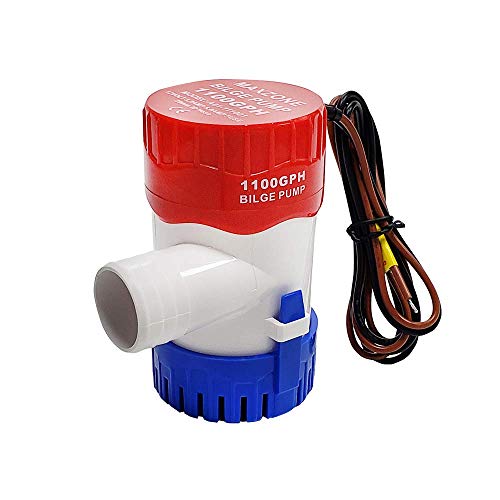
MAXZONE offers a 12V submersible bilge pump with an 1100 GPH rating and a compact form. It is non-automatic, so it requires external control or a float switch if auto-use is desired. Best for versatile installations where explicit electronic auto-control isn’t needed, or where a separate control scheme is already in place. A limitation is that without an internal auto-sensor, you’ll need to manage the pump manually or with an external switch.
Amarine Made 1500GPH 12v Bilge Pump

Amarine Made’s 1500 GPH bilge pump combines a compact size with higher flow and robust construction. The unit features a discharge-ready housing and corrosion-resistant components, aimed at boats needing a reliable upgrade to handle larger bilge volumes or more demanding pumping tasks. Best for boats with higher water intrusion or when faster drainage is required; caution that higher flow can demand stronger power supply and appropriate wiring.
Aincix 3/4 Inch Bilge Hose Kit

Aincix’s kit centers on hose routing with a 3/4 inch, 5 ft hose and two stainless steel clamps, plus a 90-degree elbow. This is ideal for upgrading or completing a bilge plumbing line where flexible routing is needed, or as a companion to an existing bilge pump. Best for precise hose runs and quick clamp-on assembly; a potential limitation is that it does not include a pump itself, so pairing with a compatible pump is necessary.
Buying Guide
- Automatic vs non-automatic: Choose automatic models for hands-off operation in boats with crew or frequent movement. Non-automatic units are better where you want manual control or have an external switch system.
- Flow rate needs: For larger bilges or faster drainage, target 1000–1500 GPH. Smaller boats or backup kits can use 500–700 GPH units.
- Hose size compatibility: Most common bilge hoses use 3/4″ or 1-1/8″ diameters. Ensure the pump outlet matches your hose and fittings, or plan for adapters.
- Installation simplicity: All-in-one kits save time but verify that included fittings match your hull and through-hull options. Consider extra clamps or adapters for custom routing.
- Durability and environment: Look for corrosion-resistant housings and stainless-steel clamps for longevity in saltwater conditions.
- Electrical considerations: Verify voltage (12V typical) and wire gauge needs. Ensure your battery could handle peak draw, especially for high-flow pumps.
- Safety and maintenance: Check whether a removable mesh filter or check valve is included to prevent backflow and ease cleaning.
Frequently Asked Questions
- What is the typical bilge pump flow rate I should look for?
Most boats benefit from 1000–1100 GPH for average bilge drainage, with higher rates (1500 GPH) for larger vessels or boats in rough conditions.
- Do I need an automatic bilge pump?
Automatic pumps are convenient for vessels with crew or frequent water intrusion. They eliminate the need to manually run the pump.
- What hoses and clamps should I pair with these pumps?
Common choices are 3/4″ or 1-1/8″ hoses with stainless-steel clamps; ensure through-hull fittings match your hose diameter.
- Is a built-in float switch necessary?
Not strictly necessary if you’re using an automatic reed sensor-equipped model or a float-switch system elsewhere. Built-in sensors simplify installation.
- Can I install these pumps on all boat types?
Most are versatile for fishing boats, cruisers, and runabouts, but check mounting depth, power availability, and through-hull compatibility for your hull.
- What maintenance is required?
Regularly inspect fittings, clean filters, and verify that the discharge path remains clear to prevent backflow or clogging.