Answer: For portable outboard fuel needs, prioritize tanks that fit your engine’s fuel line, resist harsh marine conditions, and minimize evaporation. The best choices below are suited for sailors, anglers, and deck boaters alike, with different capacities to match trip length and storage space. Use the quick comparison table to narrow your pick, then read detailed notes for each product’s strengths and trade-offs.
| Product | Brand | Capacity | Hose Length | Best For |
|---|---|---|---|---|
| VEVOR Boat Fuel Tank | VEVOR | 3.17 gal / 12 L | 9.8 ft | Compact spaces, smaller craft |
| LAUCO Portable Marine Fuel Tank | LAUCO | 6.34 gal / 24 L | 9.8 ft | Medium-range outings, bigger deck boats |
| attwood 8806LPG2 | attwood | 6 gal | Not specified in data | Reliable standard option |
| PeakPursuit Portable Boat Tank | PeakPursuit | 3 gal | 9.8 ft | Lightweight, quick swap |
| Scepter 9 Gallon Portable Tank | Scepter | 9 gal | Not specified in data | Longer runs, larger craft |
VEVOR Boat Fuel Tank For Outboard Engines

Capacity: 3.17 gal / 12 L. Construction: high-density polyethylene, designed to resist aging, impact, and corrosion. Features a 9.8 ft/3 m fuel hose compatible with Yamaha connectors. The molded top handle assists transport. Best for small fishing boats, deck boats, or vessels with limited storage space.
Who it’s best for: boaters needing a compact, lightweight transfer tank that still offers a long hose for reach without refueling at the dock. Choose this if you operate a small vessel and want easy storage under seats.
Caution: Prolonged direct sunlight exposure may age the tank and cause expansion. Store away from harsh sun when not in use.
AloneGoer 3 Gallon Portable Gas Tank
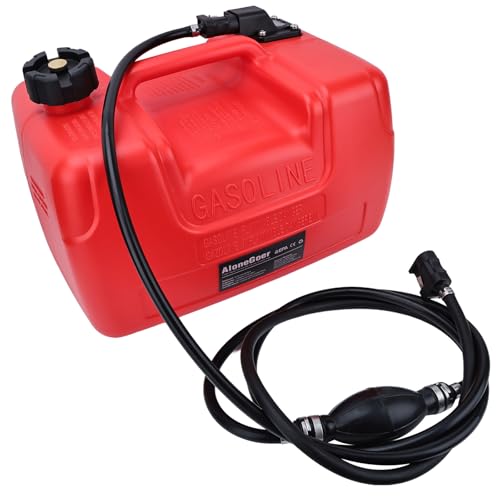
Capacity: 3 gal / 12 L. Design: multi-layer HDPE-EVOH-HDPE barrier technology to reduce fuel permeation and prevent evaporation. UV stabilization and corrosion resistance suit high-humidity, salt spray environments. Includes a connector compatible with Yamaha outboard motors (6YL-24201-24-00 replacement).
Who it’s best for: anglers or recreational boaters needing a durable, small-capacity tank with enhanced fuel retention and compatibility with Yamaha components.
Limitation: While the data shows advanced barrier technology, buyers should verify exact connector compatibility with their model before purchase to avoid mismatches.
LAUCO Portable Marine Fuel Tank

Capacity: 6.34 gal / 24 L. Hose: 9.8 ft with a 0.3″/8 mm inner diameter, designed for broad compatibility with marine tank interfaces. Construction: high-density polyethylene, with aging, impact, and corrosion resistance. Features a dual-cap design for venting or sealing as needed. Note: Avoid prolonged direct sunlight exposure to prevent aging and expansion.
Who it’s best for: mid-sized boats or deck boats requiring a larger reserve while maintaining manageable weight and storage. The dual-cap option helps control airflow and leakage during fueling.
Caution: The dual-cap system adds a step to use; ensure the cap is properly sealed during transport to prevent spills.
attwood 8806LPG2 Portable Tank

Capacity: 6 gal. Construction features automotive-grade multi-layer build for long-lasting performance in closed fuel systems. Designed to withstand extreme environments with an automatic vacuum valve for steady fuel flow. This tank provides consistent refueling without manual venting adjustments.
Who it’s best for: boaters who want a reliable, large-capacity option that maintains smooth fuel flow and reduces venting maintenance. Better for longer trips or boats with higher fuel needs.
Limitation: The data does not specify hose length; verify compatibility with your boat’s fitting before purchase.
PeakPursuit 3 Gallon Portable Tank

Capacity: 3 gal. Features a universal 9.8 ft hose with a 0.3-inch inner diameter and a dual venting system offering either sealed or vented operation. Made from impact-resistant HDPE for durability on yachts, deck boats, or inflatable craft.
Who it’s best for: boaters who want flexibility between sealed and vented modes and a medium-sized tank that’s easy to carry and store. Choose this if you value venting options to manage pressure during fueling.
Limitation: The exact cap type is not specified; confirm cap functionality to ensure compatibility with your refueling setup.
VEVOR Marine Tank 6.34-Gallon

Capacity: 6.34 gal / 24 L. Gauge: visual level indicator helps monitor fuel. Inlet and outlet separated to minimize spillage. Filled to about 80% capacity recommended to reduce evaporation and enhance safety. Hose length: 9.8 ft with a 0.3″/8 mm inner diameter for broad compatibility.
Who it’s best for: boaters needing a larger capacity with clear level monitoring and a design that reduces spilling risks during operation.
Caution: Avoid overfilling beyond 80% to minimize evaporation and leakage risk during movement.
Buying Guide
- Capacity needs: Choose capacity based on trip length and fuel economy. Small crafts may suffice with 3–4 gallon tanks, while larger boats benefit from 6–9 gallon options.
- Material and durability: Most tanks are HDPE or multi-layer HDPE; there is limited information about metal tanks in this set. Consider corrosion resistance and UV stability for outdoor storage.
- Vent vs. seal: Tanks with dual venting offer flexibility to manage pressure and flow. Sealed modes reduce fumes but require venting for pressure changes.
- Hose length and fittings: Ensure hose length reaches your fuel port without stretching. Check inner diameter compatibility with your engine’s fuel line fittings, especially Yamaha connectors if applicable.
- Storage and portability: Look for built-in handles and compact shapes to fit under seats or in lockers. Weigh the tank when full to avoid overloading your craft’s seating or storage space.
- Safety and evaporation: UV stabilization and barrier technologies help reduce evaporation. Always store away from direct sunlight when not in use.
FAQ
- Do these tanks work with all outboard motors? Most are designed to be compatible with common outboard connectors, but verify the exact connector type for your engine model.
- Is HDPE better than metal for marine tanks? HDPE is preferred for lightweight, corrosion resistance, and better resilience against salt spray; metal tanks are heavier and prone to corrosion unless specially treated.
- How do I prevent evaporation? Choose a tank with a gas-impervious barrier and consider filling to about 80% capacity to reduce evaporation and expansion risks.
- What is the ideal hose length? A longer hose provides reach but adds weight and potential sag. 9.8 ft is a common compromise for small to mid-sized boats.
- How do I know if a tank is secure during transport? Use dual-cap designs when available and ensure caps are fully sealed to minimize leaks on movement.
- Are these tanks EPA/CARB compliant? Some units mention compliance (for example, certain models), but check the product listing for current certifications and local requirements.