Direct answers for buyers seeking reliable outboard motors and compatible boat engines. This guide highlights five well-suited options across budget, power, and usage scenarios. Best for backyard boaters, small fishing trips, and inflatable or dinghy setups. The top picks emphasize durability, ease of use, and fuel efficiency, with clear notes on ideal use and potential limitations.
Summary of chosen products
| Product | Power | Best For | |
|---|---|---|---|
| NAZEAOB 18HP Outboard | 18 HP | Fast small boats, heavier loads | Heavier loads reduce speed |
| DUIBAII 18HP HangKai | 18 HP | Long runs, mid-sized inflatables | Fuel consumption varies by load |
| FXEIPOL 9 HP | 9 HP | Light inflatable, kayaks, canoes | Lower power for larger boats |
| BJTDLLX 6HP | 6 HP | Small dinghies, calm waters | Short shaft may limit depth |
| YIYIBYUS 2.3HP | 2.3 HP | Very small craft, teaching basics | Limited speed and range |
NAZEAOB 18HP Outboard Motor

Powerful 2-stroke 18 HP engine operates at 4,500 to 5,500 RPM, designed for fast travel and efficiency. Constructed from durable aluminium alloy for corrosion resistance and long-term use. Maximum load capacity reaches 2,204 pounds, making it suitable for heavier setups and more demanding outings.
Best for boaters needing strong on-water performance with significant load capacity. Choose this if you operate mid-sized boats or carry equipment and gear that add weight. Caution: heavier loads reduce top speed and acceleration.
DUIBAII 18 HP HangKai Outboard Motor

2-stroke engine with 18 HP and a maximum 5,500 RPM, offering strong speed for inflatable or mid-sized boats. Features a lightweight aluminium alloy build with corrosion resistance and a robust three-blade propeller design to reduce water resistance.
Best for long runs and rapid acceleration on lighter to mid-weight craft. Opt for this if fuel economy is balanced with performance and you value a broad fuel capacity. Caution: fuel economy varies with load and operation conditions.
FXEIPOL 9 HP Outboard Motor
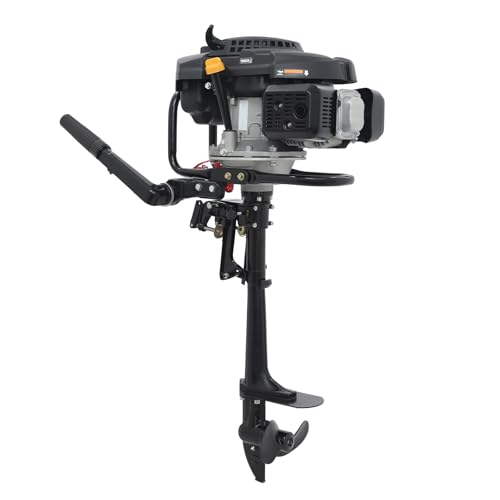
A 4-stroke 224cc engine delivering 9 HP with air cooling, designed for inflatable boats, canoes, and kayaks. Notable tilt and 360° rotation, with CDI ignition and reverse engagement via 180° turn for precise handling.
Best for lightweight craft that require smooth steering and reliable ignition with simple operation. Caution: lower power may be insufficient for larger, heavier boats.
BJTDLLX 6HP Outboard Motor

2-stroke 6 HP motor with 360° steering and a lightweight cast aluminum body. Suitable for inflatables and small fishing boats. Includes corrosion protection and a reverse gear for greater maneuverability.
Best for small watercraft and beginners who want easy, maneuverable control. Caution: may push heavy loads slowly; height and shaft length should match boat design.
PERFERATE 6HP Outboard Motor

6 HP 102cc two-stroke engine with water cooling and CDI system. Tiller control and a reliable fuel economy profile, with decent acceleration for inflatables and dinghies. Throttle and transmission provide straightforward operation.
Best for inflatable boats and small dinghies where simple, responsive control is desired. Caution: 6 HP may be underpowered for larger craft or windy conditions.
EEYBLAEEY Hangkai 12HP Outboard

12 HP 2-stroke engine with water cooling and three gears for forward, neutral, and reverse cruise. CDI ignition with a safety switch on the handle for quick stop, designed for reliability on rubber and inflatable boats.
Best for buyers needing a mid-range power option with stable cruising. Caution: 2-stroke engines generally require mix fuel and may need more maintenance than 4-stroke models.
YIYIBYUS 2.3HP Outboard Motor

52cc 2-stroke engine delivering 2.3 HP with 70 cm shaft length and a 25:1 fuel mix ratio. Aluminum and PP construction provide corrosion resistance and durability for compact craft. Idle and operating speed range supports efficient cruising.
Best for tiny boats, dinghies, or teaching beginners. Caution: limited power; not suitable for larger vessels or rough water conditions.
Buying Guide
What size and power should you choose? Match engine horsepower to your boat’s weight, hull type, and planned load. Heavier boats benefit from higher horsepower and robust build, while inflatables and dinghies favor lighter, efficient motors.
How important is fuel efficiency and maintenance? Two-stroke engines tend to require more mix fuel management and can have higher maintenance needs than modern four-stroke units. Consider fuel tank capacity, consumption rate, and ease of service in your region.
Which shaft length and mounting style fit your boat? Long shaft motors suit deeper transoms; short shafts work with shallow setups. Ensure the gearbox alignment, propeller size, and shaft length align with your boat design for optimal performance.
What about durability and environment? Aluminum alloy housings resist corrosion in salt or freshwater; a water cooling system improves reliability under heavy use. If you operate in harsh conditions, prioritize engines with robust cooling and protective features.
Ease of use and safety features? Look for CDI ignition, easy starting, and handle-mounted stop switches. For beginners, simpler throttle control and reliable reverse gear can reduce learning time and improve handling.
FAQ
- What horsepower do I need for a small inflatable? For inflatables, 6–9 HP is often sufficient for calm water and light loads; larger inflatables may benefit from 9–18 HP depending on weight and speed needs.
- Is a 2-stroke engine better than a 4-stroke for small boats? 2-stroke engines are typically lighter and offer strong power-to-weight, but may require more maintenance and fuel mixing; 4-stroke engines are heavier but often quieter and cleaner with easier maintenance.
- How do I choose shaft length? Match the engine shaft length to your boat transom height to ensure proper propeller immersion and performance.
- Can I use a car fuel for these outboards? Use the recommended fuel mix or fuel type specified by the manufacturer; some 2-stroke engines require oil-fuel mixtures.
- Are these motors suitable for saltwater? Some models are designed for both fresh and saltwater use; verify corrosion protection and maintenance requirements for saltwater conditions.
- What maintenance is essential for outboard motors? Regular inspection of lower unit oil, cooling system, spark plugs (for CDI systems), fuel lines, and propeller condition is important. Follow manufacturer guidance for service intervals.