When selecting an on-board boat battery charger, the goal is to ensure safe, efficient, and reliable charging for multiple battery types in harsh marine environments. This guide highlights top options across different bank configurations, so you can match a charger to your boat’s electrical needs and battery chemistry. Suitable buyers include recreational boaters needing simple single-bank maintenance, anglers and long-range cruisers with multiple deep-cycle batteries, and anglers who require robust, water-resistant units for demanding conditions.
Summary of selected products:
| Product | Bank Count | Output (A) | Best For |
|---|---|---|---|
| NoCO GEN5X2 | 2 | 10 | Two-battery systems, high-performance marine use |
| NoCO GEN5X3 | 3 | 15 | Three-battery setups, heavy-duty charging |
| NoCO GEN5X1 | 1 | 5 | Single-bank simplicity, compact install |
| FirstPower Pro 5X2 | 2 | 10 | All-around 12V lead-acid and Li batteries |
| SOARFLY 3 Bank 30A | 3 | 30 | Balanced multi-bank charging for varied chemistries |
NOCO GEN5X2: 2-Bank, 10A Onboard Battery Charger
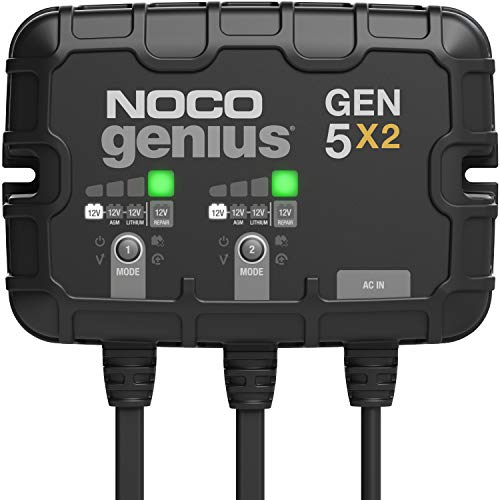
Best for: Boat owners needing two independent charging banks with robust protection and temperature compensation. This charger provides 5A per bank, enabling simultaneous maintenance of two 12V batteries, including lead-acid and lithium options. Its compact form is designed for tight engine rooms and harsh marine environments. The modes cover 12V, AGM, Lithium, and a Repair option for tricky batteries, ensuring tailored charging for diverse setups.
Why selected: The GEN5X2 offers strong multi-bank performance in a compact package, with per-bank control and protective features that help prevent overcharge and thermal issues. The independence of each bank improves reliability when batteries vary in health or chemistry.
Caution: Ensure adequate ventilation and proper wiring to prevent heat buildup in confined spaces. Always follow manufacturer guidelines for mounting and temperature compensation.
NOCO GEN5X3: 3-Bank, 15A Onboard Battery Charger
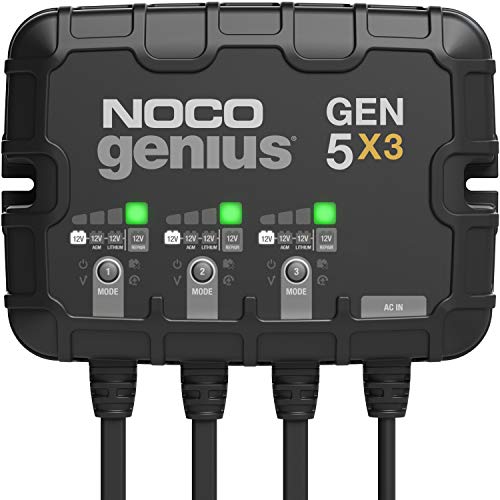
Best for: Boats with three distinct battery banks or complex systems needing parallel but independently managed charging. With 5A per bank across three banks, it handles multiple battery types and keeps each bank on its own charging schedule. Suitable for larger vessels or fleets with separate starting, house, and auxiliary batteries.
Why selected: The three-bank architecture provides flexible charging across diverse battery chemistries while maintaining safe, individual bank control and protective features like temperature compensation and overcharge protection.
Caution: Larger installation footprint may require more space and proper mounting considerations in cramped compartments.
FirstPower Pro 2 Bank Marine Battery Charger 5X2

Best for: Two-battery setups requiring IP68 waterproofing and 24/7 onboard charging capability. This unit supports 12V lead-acid and lithium batteries, with independent mode selection per bank for SLA/AGM, Lithium, and Calcium. It is designed for continuous operation in marine environments.
Why selected: Its 5A per bank deliver adequate charging for mid-sized boats while maintaining robust water resistance and flexible mode selection, making it a well-rounded option for boats with dual-battery needs.
Limitation: Ensure compatible battery types are selected via MODE correctly to maximize charging efficiency and longevity.
SOARFLY 3 Bank Marine Battery Charger

Best for: Boats with three independent circuits needing a comprehensive charging solution for SLA/AGM, Lithium (LiFePO4), and Calcium batteries. Independent charging per bank allows optimized charging for each battery type, with a total of 30A across all banks.
Why selected: The three-bank design covers diverse chemistries in one unit, simplifying wiring and monitoring while ensuring engines and house systems receive appropriate power. The model’s force/Repair mode supports revived batteries that dip below 1V.
Caution: The more banks and modes you use, the more careful you must be with programming and monitoring to avoid cross-charging issues or confusion about mode selection.
Buying Guide
Key considerations when choosing an on-board boat battery charger include bank count, total current, battery chemistry support, waterproofing, and mounting needs. The right charger aligns with both your boat’s electrical system and your battery chemistry.
- Bank count: How many batteries require simultaneous charging? A two-bank unit suits most mid-sized boats; three-bank options are better for boats with separate starting, house, and auxiliary batteries.
- Output per bank: Look for 5A per bank for standard deep-cycle and lead-acid setups, or higher totals (10A-15A) when charging larger or LiFePO4 batteries quickly.
- Battery compatibility: Ensure the charger supports lead-acid, AGM, Gel, and Lithium chemistries if you use mixed batteries.
- Charging modes: Independent mode per bank helps tailor charging to each battery’s chemistry, improving longevity and performance.
- Waterproof/installation: Marine-grade IP ratings (IP68 or similar) help protect the unit from water exposure. Consider installation space and mounting options, especially near engine compartments.
- Repair and dead-battery charging: Some models include Repair or Force modes to revive deeply discharged batteries, though ongoing use should follow manufacturer guidance.
- Temperature compensation: Chargers with temperature sensing adjust charging based on ambient temperature to prevent overcharging in heat and undercharging in cold.
FAQ
- What is the advantage of a multi-bank charger? It allows independent charging and maintenance for each battery, reducing cross-charging and improving overall battery health on boats with multiple batteries.
- Can I use a marine charger for LiFePO4 batteries? Yes, if the charger explicitly supports LiFePO4 or Lithium chemistry and has suitable modes for Lithium batteries.
- Do I need a waterproof charger? Yes, marine environments expose chargers to moisture. Look for IP-rated units designed for 12V systems.
- Should I choose a 2-bank or 3-bank charger? Choose based on the number of batteries you routinely charge at once and the complexity of your system. A 3-bank unit is helpful for boats with three distinct battery roles.
- What is temperature compensation in charging? It adjusts charging voltage in response to ambient temperature to prevent overcharging in heat and undercharging in cold.
- Are there any installation cautions? Ensure proper mounting, secure wiring, and ventilation as needed. Follow all safety guidelines for high-current DC devices on boats.