Answering the question: the best onboard chargers for boats are compact, multi-bank devices that handle lead-acid and lithium batteries with temperature compensation and safety protections. This guide highlights five models suited for different boat sizes and battery setups, from small vessels to larger cruisers. Ideal buyers include anglers needing reliable daily maintenance, weekend boaters seeking easy upgrades, and captains managing diverse battery chemistries. The following table summarizes the five chosen products for quick comparison.
| Product | Bank Count | Max Total Amps | |
|---|---|---|---|
| NOCO Genius GEN5X2 | 2 | 10A | Medium boats with multiple 12V batteries |
| NOCO Genius GEN5X1 | 1 | 5A | Small boats or single-battery setups |
| NOCO Genius GEN5X3 | 3 | 15A | Boats with three battery banks |
| NOCO GENPRO10X2 | 2 | 20A | Higher-demand systems on mid-to-large boats |
| Minn Kota 1823155 MK 315D | 3 | 15A | Truly marine-focused with precise control |
NOCO Genius GEN5X2: 2-Bank 10A Onboard Battery Charger

Best for boats with two independent 12V battery banks requiring reliable, interchangeable charging. The GEN5X2 delivers 5A per bank and supports lead-acid and lithium options. Its modes include 12V, 12V AGM, 12V Lithium, and a 12V Repair Mode, enabling targeted maintenance and fast recovery for discharged batteries. The compact design helps fit cramped electrical spaces on smaller boats.
Who it’s for: boat owners with two batteries or separated systems (house and starting), who want precise bank control and robust protection against overcharging. Limitations: 37% smaller than some predecessors, but still a two-bank charger; if you need three banks, consider GEN5X3.
NOCO Genius GEN5X1: 1-Bank 5A Onboard Battery Charger
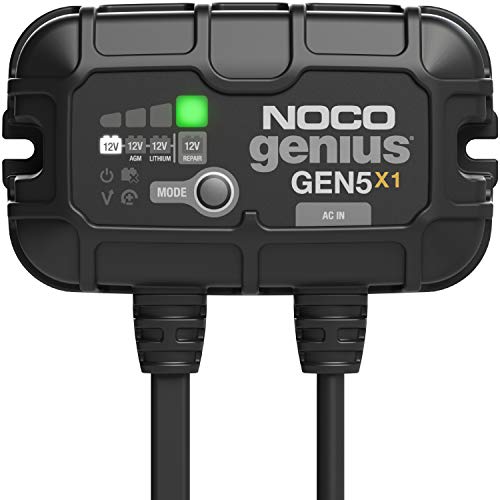
Better for solo-battery setups or compact boats, the GEN5X1 provides a single 5A charging channel. It shares NOCO’s same protective features and selectable charging modes (12V, 12V AGM, 12V Lithium, and 12V Repair Mode). This unit is convenient where space is the primary constraint and only one battery wants intelligent charging and maintenance.
Who it’s for: owners with one main battery or a spare that doesn’t demand multi-bank balancing. Limitations: Limited to one bank, so not ideal for boats with multiple independent batteries expecting independent charging.
NOCO Genius GEN5X3: 3-Bank 15A Onboard Battery Charger
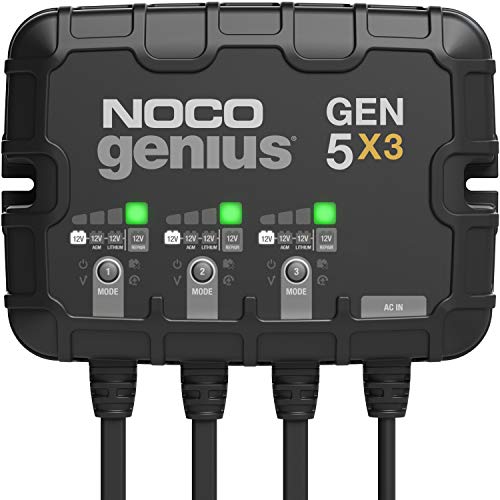
This model targets boats with three separate 12V battery banks needing synchronized or independent charging. It provides 5A per bank across three banks for a total of 15A. It includes the same charging modes and protections as the smaller GEN5X models. The GEN5X3 is a solid choice when you want full bank independence while keeping a compact footprint.
Who it’s for: boats with three batteries requiring balanced charging and maintenance. Limitations: Higher power draw means more space and wiring considerations; choose this if you truly need three independent banks.
NOCO GENPRO10X2: 2-Bank 20A Onboard Battery Charger

Best for higher-demand electrical setups, the GENPRO10X2 delivers 10A per bank across two banks, improving charging speed for larger boats or deep-cycle configurations. It supports 12V AGM, 12V Lithium, and other modes with temperature compensation and overcharge protection. This unit is designed for more robust marine electrical systems.
Who it’s for: boats with higher daily usage or multiple high-drain batteries. Limitations: Higher amperage requires careful wiring and space; ensure your system can handle the load.
Minn Kota 315D Digital On-Board Marine Battery Charger

The Minn Kota 315D is a three-bank charger with a 5 Amp per bank configuration. It emphasizes automatic temperature compensation and a microprocessor-based digital control system, guiding users through charge stages and maintenance. LED indicators provide clarity on charge status and errors, aiding maintenance schedules on boats with varied battery chemistries.
Who it’s for: boat owners who want digital control and clear status indicators for a three-bank setup. Limitations: Brand-specific interface; ensure compatibility with your preferred battery types and installation space.
Buying Guide: Key Purchase Considerations
- Bank count vs. boat needs: Match the number of charging banks to the number of independent battery groups on your boat. More banks offer better management of separate systems (house, starting, trolling, etc.).
- Battery chemistry support: Verify compatibility with lead-acid, AGM, gel, and Lithium (LiFePO4). Some models tailor modes per battery type.
- Charging modes and protection: Look for selectable modes, temperature compensation, overcharge protection, and repair modes for deeply discharged batteries.
- Waterproofing and marine-grade build: Ensure the charger is rated for marine use and has IP68 or equivalent protection for exposure to splashes and humidity.
- Installation considerations: Assess space, mounting options, wiring gauge, and the ease of adding future upgrades or additional banks.
- Maintenance and indicators: Clear LED indicators or a digital interface helps track charging stages, maintenance mode, and fault alerts.
- Reliability and serviceability: Choose brands with proven marine performance and accessible customer support for field maintenance.
Frequently Asked Questions
- What is an onboard battery charger for boats? A device that charges one or more 12V marine batteries from the boat’s power source, with protections and modes tailored for marine use.
- Do I need a multi-bank charger? If your boat has separate house and starting batteries, or multiple batteries in different banks, a multi-bank charger helps balance charging and maintenance.
- Can I use lithium batteries with these chargers? Yes, many models offer dedicated Lithium modes, but confirm compatibility and recommended charging parameters for your exact LiFePO4 or other lithium chemistries.
- What maintenance mode does? Maintenance mode keeps batteries topped up at a safe float voltage without overheating or overcharging.
- Is temperature compensation important? Yes. Temperature compensation adjusts charging voltage to prevent undercharging in cold weather and overcharging in hot conditions, extending battery life.
- Are marine chargers waterproof? Many are IP-rated for marine environments, but always verify the model’s rating and install in a protected area.