This guide helps buyers find the best online marine chart plotters for plotting courses, measuring distances, and transferring bearings on nautical charts. The top picks below are suited to coastal cruisers, sailing students, and professional mariners who need reliable paper-chart tools when GPS is limited or unavailable. Each product is chosen for clarity of scales, durability, and practical on-chart usability. A quick buying table follows to compare strengths at a glance.
Quick comparison
- Weems & Plath Marine Navigation Parallel Plotter — Best for traditional, durable plotting with fixed distance scales.
- Liquidraw Portland Course Plotter — Best for all-in-one plotting with built-in protractor and dividers.
- Part Synergy Marine Cartography — Best for digital-ready, chart-card compatibility and Pacific coverage.
- Mariners Chart Plotting Tool Kit — Best for complete plotting sets and exam preparation.
- Brilluxa Station Pointer — Best for precise three-point chart positioning on paper charts.
Weems & Plath Marine Navigation Parallel Plotter

The Weems & Plath parallel plotter uses a durable acrylic body mounted on a marine-grade aluminum roller assembly. It includes distance scales at 1:20,000, 1:40,000 and 1:80,000 to fit U.S. Coast and Harbor Charts, plus inch and nautical mile scales for flexible plotting. Best for traditionalists who want a robust, long-lasting tool that remains readable on deck regardless of weather.
Who it’s best for: mariners who prefer classic plotting methods and need reliable, fixed-scale rulers that endure salt air and handling. Limitations: may require complementary tools for modern digital chart workloads.
Liquidraw Portland Course Plotter With Marine Protractor
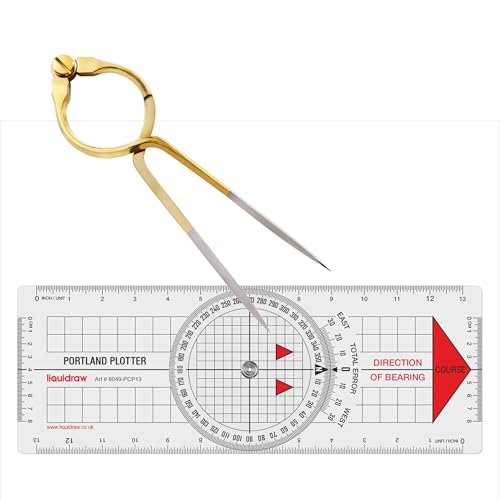
This all-in-one marine navigation set combines a Portland course plotter with a built-in protractor and an 8″ single-handed brass divider. It supports accurate chart plotting, measuring distances, and transferring bearings on paper charts. Best for coastal cruising and training where a compact, integrated toolkit is preferred. The durable transparent acrylic with bold scale markings ensures legibility onboard.
Who it’s best for: sailors and ASA/RYA students who want a single, versatile plotting kit. Limitations: brass components may require occasional maintenance to preserve smooth operation in salty environments.
Part Synergy Marine Cartography With Chart Plotters

Marine Cartography by Part Synergy focuses on chart card compatibility and detailed coverage of Pacific Island areas. The package supports SD or Micro-SD card formats and works with Garmin Navionics+ chart data. This option suits buyers who rely on digital chart cards and want easy access to extensive marine navigation data. Best for expedition planning and charting remote island routes.
Who it’s best for: mariners using chart cards and needing reliable digital-to-paper transition help. Limitations: not a standalone plotting ruler; designed to complement chart cards rather than replace traditional rulers.
Mariners Chart Plotting Tool Kit

Mariners Chart Plotting Tool Kit offers a complete set for nautical plotting. It includes a 12″ parallel ruler, dividers, pencils, eraser, sharpener, notepad, calculator, and magnifier. This kit is ideal for exam preparation and on-water plotting when GPS is unreliable or disallowed. Best for students and crews who want a comprehensive plotting suite in one package.
Who it’s best for: maritime students and sailing crews preparing for examinations or navigation exercises. Limitations: heavier and bulkier than single-function tools; not ideal for minimalist setups.
Buying Guide
What makes a plotting tool suitable for online purchase?
Look for clear scale readability, durable materials, and compatibility with your preferred chart format. A tool should translate well from paper charts to practical on-board use, including deck-friendly construction and corrosion resistance.
Should you choose all-in-one sets or individual tools?
All-in-one sets save space and ensure compatibility between rulers, dividers, and protractors. Individual tools let buyers tailor a kit to specific chart types or training needs. For beginners, a complete kit reduces missing components. For advanced users, independently selected tools can optimize deck space and workflow.
What chart types and scales matter most?
Key scales include 1:20,000, 1:40,000, and 1:80,000 for U.S. coastal charts, plus nautical miles and statute miles. Versatile tools offer dual-side readability and built-in protractors for quick angle measurements. Consider whether your charts are digital, analog, or both when choosing a tool set.
Material and durability considerations
Durability matters in marine environments. Acrylic and brass components offer good visibility and longevity. Tools should resist fading under sun exposure and handle salty air without corroding quickly. Weight and balance matter for ease of handling on a moving vessel.
Digital compatibility and chart formats
Some products support SD or Micro-SD cards and digital chart formats like Navionics+. If you alternate between digital and paper charts, consider tools that bridge both worlds and provide easy transfer between formats.
Best picks by use-case
- Best for traditional, rugged use: Weems & Plath Parallel Plotter
- Best all-in-one on-board kit: Liquidraw Portland Plotter Set
- Best for digital chart card integration: Part Synergy Marine Cartography
- Best for complete plotting sets and exam prep: Mariners Chart Plotting Tool Kit
- Best for precise chart positioning: Brilluxa Station Pointer
FAQ
1. What is a chart plotter used for? It helps plot courses, measure distances, and transfer bearings on nautical charts, especially when GPS is limited or unavailable.
2. Are these tools legal substitutes for GPS? They are traditional navigation tools and supplements. They do not replace modern electronic navigational systems in all scenarios but remain useful for training and paper-chart navigation.
3. Which material lasts longest on deck? Acrylic and brass components generally withstand marine conditions well, but proper maintenance helps preserve them longer.
4. Can these tools work with digital charts? Some models support SD or Micro-SD cards and digital chart formats; others are designed for paper charts and do not integrate directly with digital systems.
5. How should I store these tools when not in use? Clean and dry them, store in a protective case, and keep away from direct sun to prevent fading or warping of scales.
6. Is a complete plotting kit necessary? A complete kit simplifies on-water use and exam preparation. It provides all essential tools in one package, reducing the chance of missing parts.