If you’re evaluating outboard fuel water separators, you want reliable filtration that protects your engine and keeps fuel flow steady. This guide highlights five well-matched options, showing who each is best for and why. These choices suit anglers, weekend boaters, and commercial skippers alike who need dependable water separation, easy maintenance, and compatibility with common marine engines.
| Product | Best For | Key Benefit |
|---|---|---|
| S3213 Fuel Water Separator Marine Kit (TRSCJXN) | Universal compatibility for Yamaha, Mercury, Racor, Sierra, Suzuki | 10-micron filtration with 3/8″ NPT ports for smooth fuel flow |
| R12T Marine Fuel Water Separator Kit | Gasoline and diesel outboards needing easy drain design | Spin-on design with reusable clear bowl and self-draining valve |
| Quicksilver 802893Q01 Fuel Filter | Mercury/Mariner and MerCruiser systems requiring OEM-aligned specs | 25-micron filtration for robust contaminant removal |
| Arbriaty S3213 Style Fuel Water Separator | Broad compatibility with major brands | Clear bowl, 10-micron efficiency with direct-fit parts |
| CARMOCAR Marine Fuel Water Separator | Universal outboard replacements needing 3/8″ ports | 10-micron filtration, durable brass fittings |
S3213 Fuel Water Separator Marine Kit

The TRSCJXN S3213 kit is designed for multiple brands, including Yamaha, Mercury, Racor, Sierra, and Suzuki. It replaces several Mercury and Yamaha part numbers, making it a versatile choice for universal marine use. This model emphasizes the 3/8″ NPT ports for smooth fuel flow and a 10-micron filter to capture fine particles and water, protecting fuel systems from contaminants. Best for boaters seeking a single, broad-application solution that reduces inventory complexity.
Who it’s best for: boaters with mixed-brand setups or a need for a universal replacement. Why selected: broad compatibility and efficient filtration help prevent fuel-system issues across different engines.
Caution: verify fitment with your exact engine model and note that universal kits may require adapters for precise alignment in some installations.
R12T Marine Fuel Water Separator Kit

The R12T kit is designed to fit R12T marine fuel water separators and features a spin-on filter with a reusable clear nylon bowl and self-draining valve. The design makes it easy to monitor fuel condition visually and drain water without disassembly. Its direct-fit bottom outlet facilitates convenient water drainage, reducing maintenance time. Best for boaters who value ease of inspection and quick maintenance during routine fueling.
Who it’s best for: those who prioritize straightforward maintenance and quick water drainage. Why selected: clear bowl and self-draining valve simplify daily checks and upkeep.
Caution: ensure the port sizes align with your current filter setup to avoid mismatches during installation.
Quicksilver 802893Q01 Water Separating Filter
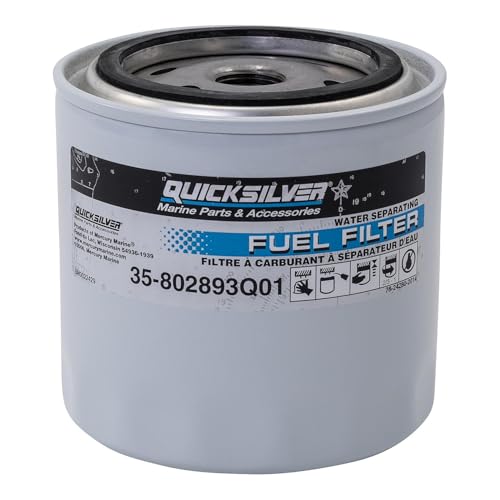
Quicksilver’s 802893Q01 is designed to Mercury and Mariner systems and adheres to Mercu ry Marine OEM-like specifications to protect engines. The 25-micron filtration helps remove contaminants effectively, balancing filtration strength with fuel flow. Best for buyers seeking compatibility with Mercury/Mariner equipment and OEM-style protection.
Who it’s best for: Mercury- or MerCruiser-focused installations requiring OEM-aligned filtration. Why selected: OEM-compatible design supports reliable engine protection.
Caution: a 25-micron filter may be less aggressive against ultra-fine particles than 10-micron options; consider your fuel quality and engine needs.
Arbriaty S3213 Style Fuel Water Separator

Arbriaty’s universal-style separator emphasizes broad compatibility with Yamaha, Mercury, Racor, Sierra, and Suzuki engines. It uses a clear nylon bowl for quick visual checks and a 10-micron filtration level to balance debris removal with fuel flow. Best for multi-brand operators who want a visual indicator of fuel condition and straightforward maintenance.
Who it’s best for: multi-brand fleets or boats with mixed engine lineups. Why selected: clear bowl and universal fit reduce inventory and simplify maintenance.
Caution: confirm exact thread sizes and gasket compatibility with your engine’s mounting hardware before purchase.
CARMOCAR Marine Fuel Water Separator

The CARMOCAR unit targets universal outboard replacements with 3/8″ NPT ports and a 10-micron filtration level. It emphasizes durability with brass fittings and a robust filter element designed to trap water and fine debris. Best for boaters needing a sturdy, all-purpose separator with brass fittings for durable installation.
Who it’s best for: users prioritizing robust construction and universal compatibility. Why selected: strong filtration and brass fittings support long-term use in rough marine environments.
Caution: verify the exact replacement part numbers your engine requires to avoid misfit parts in complex systems.
Buying Guide: How to Choose the Right Outboard Fuel Water Separator
What should you consider when selecting a fuel water separator for your outboard? Start with engine compatibility and port size. Look for 3/8″ NPT or M18 × 1.5 port configurations that match your system’s connections.
Filtration rating matters. A 10-micron element captures finer water droplets and particulates than higher micron ratings, which helps protect sensitive fuel injectors but may constrain flow slightly. If your fuel is clean, a 10-micron standard is a solid balance; otherwise, you might need a slightly coarser option for higher flow.
Visibility and maintenance ease can save time. Clear bowls let you see water and sediment levels, and self-draining valves reduce maintenance effort. Spin-on designs simplify replacement without tools in many cases.
Brand compatibility should align with your engine lineup. If you have Mercury/Mariner-only equipment, an OEM-aligned part may be preferable. For boats with multiple brands, universal kits reduce inventory needs but may require extra verification on mounting hardware.
Practical questions to guide your choice
- Do you operate multiple engine brands or a single-brand system?
- Are you mainly concerned with water removal efficiency or overall fuel purity?
- Is ease of maintenance a priority, such as drain valves and clear bowls?
- What is your engine’s recommended port size and thread type?
- How important is OEM compatibility versus universal fit?
Installation considerations at a glance
- Place the separator in the fuel line upstream of the engine, following manufacturer guidelines for orientation.
- Ensure clamps and fittings are compatible with the fuel line material to prevent leaks.
- Check for any required gaskets or seals and replace if degraded.
- After installation, prime the system and inspect for leaks before final operation.
FAQ
- Q: What does a 10-micron rating mean for my engine protection?
A: It indicates the smallest particles the filter can effectively capture; smaller microns catch finer contaminants, improving protection but potentially reducing flow if the engine requires high fuel volume. - Q: Can I mix different brands of fuel water separators on one system?
A: It’s best to use components designed for your specific engine configuration or universal kits that match the port sizes and thread types to avoid fitting or performance issues. - Q: How do I know if I need a 25-micron or 10-micron element?
A: If fuel quality is consistently clean and you want maximum flow, a coarser 25-micron element may suffice. For environments with more water or debris, a 10-micron element offers stronger filtration. - Q: Are replacement bowls and drains always necessary?
A: Clear, reusable bowls simplify inspection and maintenance; ensure you perform regular checks and drain water when present to protect your engine. - Q: Do universal fuel water separators require adapters?
A: Some setups may require adapters or additional fittings; verify compatibility with your exact hose sizes, clamps, and mounting hardware before purchasing.