Answering the needs of pontoon boat owners seeking a reliable dash panel setup, this guide highlights practical 6- or 5-gang switch panels and compatible dash components. Best for DIY boaters who want durable, marine-grade panels with USB charging, voltmeters, and easy wiring. Top picks suit pontoon operators who want simple control of lights, accessories, and power on a single dash. The selection emphasizes water resistance, clear voltage monitoring, and straightforward installation.
Summary table of selected products
| Product | Best For | Key Benefit |
|---|---|---|
| Kohree 6 Gang Marine Boat Rocker Switch Panel | All-around dash control | USB touch switch, voltmeter, multiple outputs |
| FXC 5 Gang Aluminum Panel | Compact screens and durable build | Aluminum panel, IP66 waterproof, dual USB |
| DaierTek 6 Gang Marine Panel | Budget-friendly, USB charging | Dual USB, cigarette lighter, blue LED |
| Nilight 6 Gang ON/OFF Panel | Voltage monitoring and protection | Voltmeter, overload protection, USB |
| GGTA 6 Gang Aluminum Panel | Vehicle versatility | 12V/24V compatibility, dual LED |
Kohree 6 Gang Marine Boat Rocker Switch Panel

This 6-gang panel suits pontoon dashboards needing integrated controls with power-saving features. It includes a USB charging port with a dedicated USB Touch Switch to cut power when unused. The blue LED voltmeter helps monitor battery health, while six on/off rockers give clear circuit control. Best for boaters who want a compact, all-in-one panel with built-in protection.
Best for: Pontoon operators who want a single, centralized control hub that includes a digital voltage display and USB charging.
Caution: The USB touch switch is designed to save power, but ensure proper wiring to avoid accidental deactivation of critical circuits.
FXC Waterproof Marine Boat Rocker Switch Aluminum Panel 5 Gang
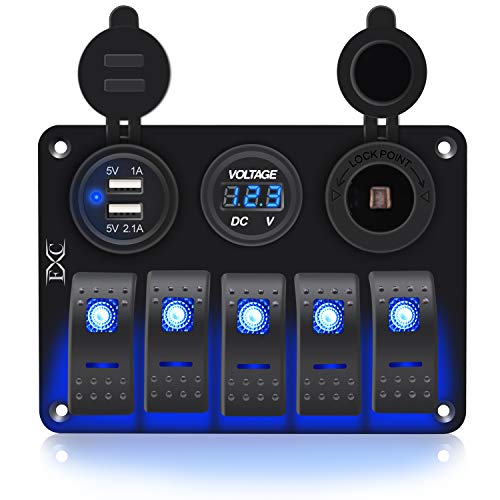
This 5-gang panel emphasizes rugged aluminum construction with IP66 waterproof rating, making it well-suited for exposed dash areas on pontoon boats. It includes a dual USB charger and volt meter, plus a cigarette socket. Best for: boaters who need a sturdy, water-resistant panel that fits larger dashboards and supports 12V–24V systems.
Limitation: Slightly larger footprint may require more dash space; verify installation dimensions before purchase.
DaierTek 6 Gang Marine Switch Panel

DaierTek’s panel features dual LED lighting for visibility in low light, plus a cigarette lighter socket and dual USB ports. It’s designed for 12V–24V systems with waterproofing, making it a practical choice for pontoon dashboards that require easy access to charging and lighting switches. Best for: budget-conscious boaters who still want a recognizable glow and reliable power switching.
Limitation: The data doesn’t specify IP rating beyond “waterproof”; confirm environmental exposure on your boat’s dash.
Nilight 6 Gang ON/OFF Panel

Nilight combines six rocker switches with a voltmeter, a cigarette socket, and dual USB, offering reliable overload protection. Its pre-wired setup and mounting screws simplify installation on pontoon dashboards. Best for: DIY installers who want a complete power-monitoring solution with built-in safety features.
Limitation: Some users may prefer more compact dimensions; measure dash space to ensure a clean fit.
GGTA 6 Gang Aluminum Panel

GGTA’s aluminum panel supports 12V and 24V systems, with dual LED indicators and a 7.09″ x 2.68″ footprint. This panel is designed for marine and automotive use, offering flexible orientation for dash layouts. Best for: pontoon rigs requiring cross-vehicle compatibility and a lightweight, durable build.
Limitation: Installation orientation options are described, but ensure hole-cutout dimensions match your dash precisely.
Buying Guide: Key Considerations For Pontoon Dash Panels
What should you look for when choosing a dash panel for a pontoon boat? Start with voltage compatibility (12V vs. 24V) to ensure the panel matches your boat’s electrical system. Consider IP or water-resistance ratings if the dash area is exposed to spray. Look for integrated features such as voltmeters, USB charging, and cigarette lighter sockets for comprehensive power management.
How many switches do you need? For basic lighting and accessories, a 5- or 6-gang panel is usually sufficient. If you require more components, consider two panels or a larger model that can be correctly spaced on the dash. Ensure the panel includes proper fusing or safety protection to prevent wiring faults from damaging equipment.
What about installation and space? Measure dash depth, cutout dimensions, and mounting options (horizontal vs vertical). Aluminum panels tend to be more durable in marine environments, but check for corrosion resistance and mounting hardware quality. LED indicators help identify active circuits quickly in dim conditions.
Power management matters. Panels with voltmeters let you monitor battery health in real time, reducing the risk of unexpected voltage drops. USB ports are convenient for charging devices on board, but verify if a USB switch is included to cut standby power when idle.
Compatibility with existing equipment is essential. Look for panels that can control common 12V accessories like lights, bilge pumps, speakers, and many USB-powered devices. If your dash uses 24V systems elsewhere, verify dual-voltage support and the correct wiring diagram before installation.
Frequently Asked Questions
- Q: Do these panels require professional installation?
- A: Not necessarily; many are designed for DIY installation with pre-wired harnesses and clear wiring instructions. If dash space is tight or you’re uncomfortable with 12V wiring, a professional installation is advised.
- Q: Can I mix and match panels on the same dash?
- A: Yes, as long as voltage ratings and fuse protections are compatible and the dash can physically accommodate the different sizes and mounting orientations.
- Q: Are the USB ports DC fast-charging capable?
- A: Some models advertise higher-output USB ports (e.g., QC 3.0). Check the product specs for current ratings to ensure compatibility with your devices.
- Q: What should I do about wiring safety?
- A: Use appropriate fuses, verify polarity, and follow a proper wiring diagram. Marine-grade components and IP-rated panels reduce risk, but correct installation remains essential.
- Q: How can I tell if a panel is suitable for 12V or 24V systems?
- A: Look for explicit voltage compatibility in the features. Many panels support both 12V and 24V, but confirm to avoid overload or improper charging.