When docking a pontoon, the right mooring whip system minimizes hull damage and makes tying up quicker and safer. This guide highlights five top options designed for pontoon boats, focusing on durability, ease of use, and how each is best suited for different docking scenarios. If you frequently encounter wake, wind, or varying tides, these picks help you choose the best fit for your boat size and dock setup.
Buyer’s quick-start summary table:
- SIVEIS 8FT Fiberglass Mooring Whips — Best for small pontoons up to 18 ft; compact kit with 180° adjustability.
- Dockmate Ultimate 12′ Mooring Whips — Best for medium-sized docks; spring action for strong protection.
- TaylorMade Standard Mooring Whips 16′ — Best for boats 20–33 ft; longer reach and fixed or rocker arm options.
- SFNSM 2 Pack Mooring Whips — Best value pair; sturdy dock rods with weather-ready design.
- TaylorMade BoatGuard Mooring Whips 8′ — Best for smaller boats up to 25 ft; compact and easy to handle.
SIVEIS 8FT Fiberglass Mooring Whips — 2 Pack

Best for small boats up to 18 ft or 2,500 lbs, these 8FT fiberglass mooring whips are assembled to an effective 7.2FT length. They deliver spring-like cushioning to maintain a 2–3 foot gap from the dock while absorbing waves, wind, tides, and wakes. The 316 stainless steel bases provide corrosion resistance and secure mounting with 0°–180° adjustability for dock angle changes. Includes two adjustable bases, two ropes with eye loops, two nylon pulleys, cleats, screws, and wrenches for quick setup. This kit is ideal for compact docks and boats that need strong protection without taking up heavy space. Caution: the effective length is slightly shorter when assembled, so measure your dock clearance before installing.
Who this is best for: Small pontoon owners who want a compact, corrosion-resistant, easy-to-install mooring solution that can handle typical weekend-use conditions on modest docks.
CSUPPCREA 16″ Heavy Duty Stainless Hooks Dock Defender Rods
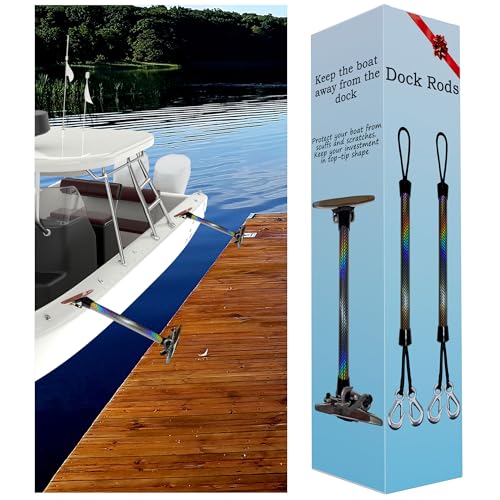
Best for quick, knot-free docking with robust hardware, this 2-pack provides heavy-duty stainless steel clips and galvanized dock poles designed to withstand harsh marine conditions. The design emphasizes simple, fast tie-up processes, making it easier to secure a pontoon without fiddling with ropes. Best used when you want a straightforward, rugged docking experience and you rarely change dock locations. Caution: the product is described as galvanized steel with clips, so ongoing exposure to saltwater requires periodic maintenance to preserve the finish.
Who this is best for: Dockers seeking fast, reliable dock connections with less rope work, especially when dock systems favor metal-to-pole attachments.
Dockmate Ultimate 12′ Mooring Whips

Best for protecting larger pontoons and keeping a safe buffer between the boat and dock, Dockmate Mooring Whips use heavy-diameter fiberglass and a roller tip with a tensioner for easy one-handed operation. The set includes adjustable aluminum bases and rubber shock absorbers to dampen wake. This option is well-suited for boats exposed to frequent wind or wakes, where proactive spring action helps absorb impact. Caution: check base compatibility with your dock’s mounting surface before purchase.
Who this is best for: Pontoon owners who want a high-strength, go-to solution with simple one-handed use and quick storage.
TaylorMade Standard Mooring Whips 16′

Best for boats in the 20–33 ft range or up to 20,000 lbs, these mooring whips come in standard and premium versions with fixed or rocker arm bases. The fiberglass construction provides durability, while the low-friction tip and whip cleat enable easy boarding. They help position the boat safely away from the dock to reduce contact during rough conditions. Caution: longer whips require adequate deck space and appropriate mounting hardware to ensure load distribution.
Who this is best for: Pontoon owners needing longer reach and stronger protection for mid-to-large vessels, especially on docks with limited clearance at the edge.
TaylorMade BoatGuard Mooring Whips 8′

Best for smaller pontoons up to 25 ft and 10,000 lbs, these 8′ whips provide a compact yet effective protection solution for docking in tight spaces or on crowded piers. The rocker arm base supports positioning away from the dock, with a low-friction tip and whip cleat designed for easy boarding. Caution: shorter reach may be less effective in wide slips or strong wakes on larger vessels.
Buying Guide: Key Considerations
When choosing pontoon mooring whips, consider length, load capacity, dock type, and how you plan to use them. Longer whips offer more distance from the dock but require space and proper mounting. Fiberglass is favored for its balance of strength and flexibility, while stainless steel components resist corrosion in saltwater environments.
- Match the whip length and rated weight to your pontoon. Larger boats require longer whips and more robust bases.
- Check dock edge design and mounting surfaces. Some whips use flat bases, others require specific cleats or bollards.
- All-in-one kits save time but ensure you have the right tools for mounting into wood, concrete, or metal docks.
- Inspect clamps, bases, and ropes regularly; replace worn components to maintain effective protection.
- If you dock at multiple locations, consider a lighter, compact model for quick setup and takedown.
Frequently Asked Questions
- What makes mooring whips better than ropes? Mooring whips provide a controlled buffer that reduces direct contact with the dock and absorbs motion from waves and wakes, protecting the hull and fenders.
- How do I choose whip length? Select length based on boat size, dock gap, and typical wake. Longer whips offer more distance but require space for mounting.
- Are stainless steel bases necessary? Stainless bases resist corrosion and are ideal in saltwater environments, contributing to longer service life.
- Can I install these myself? Yes, most kits are designed for DIY installation on wood, concrete, or steel docks. Follow included instructions and use proper hardware.
- What maintenance is required? Regularly inspect the poles, bases, and clips for wear or corrosion. Clean off salt and rinse after saltwater use, and tighten any loose components.
- Which option is best for tight docking spaces? A compact 8′ or 12′ whip with a rocker arm or adjustable base is often ideal for tight piers while still providing effective protection.