Answering how to safely board a pontoon boat from a trailer, this guide highlights five top options designed for stability, durability, and ease of use. Best for family boats, weekend anglers, and dock-to-deck boarding, these steps offer sturdy frames, anti-slip treads, and adjustable handrails. The products below are chosen for compatibility with common trailer tongues and varying user needs, from maximum weight capacity to left/right mounting options. Read on to compare features and choose the right step for your setup.
| Product | Brand | Capacity | Key Features |
|---|---|---|---|
| Toplamper Boat Trailer Steps with Handrail | Toplamper | 300-350 lbs | Heavy-duty steel, weather-defying finish, 3-step height with 38.5″ handrail |
| OUTPRIZE Boat Trailer Step | OUTPRIZE | 450 lbs | Adjustable left/right handrail, reinforced safety design |
| Aupar Boat Trailer Steps (3-Step) | Aupar | 3-step design, 3″ x 3″ to 5″ wide fits | Anti-slip, triangular support, secure handrail |
| MaxxHaul 70089 Heavy Duty Step | MAXXHAUL | 300 lbs | Universal frame compatibility, non-slip surface, powder coat |
| Eastrexon 4 Step Boat Trailer Steps | Eastrexon | 4 steps | Universal fit 3″–5″ tongues, anti-slip mat, safety handrail |
Toplamper Boat Trailer Steps With Handrail

Best for: Families seeking a balance of price and durability in a 3-step setup. This model offers a 38.5-inch handrail, a stable three-step layout, and a rust-resistant matte black finish that stands up to sun and salt. The 300-350 lb rating provides confidence during boarding after a day on the water.
Why chosen: It combines heavy-duty steel construction with weather resistance and an accessible height range, making it suitable for most pontoon trailer configurations without crowding the boarding area.
Caution: Check trailer frame compatibility before mounting, as some tongues may require additional adapters for a perfect fit.
OUTPRIZE Boat Trailer Step

Best for: Boat owners needing a higher weight capacity and adjustable handrail to avoid interfering with the boat edge. The 450 lb capacity and right/left-handrail options provide flexible installation on various trailers.
Why chosen: The reinforced triangle supports and wider pedal with anti-slip pad emphasize safety on wet surfaces, making it a solid choice for frequent boaters or larger pontoons.
Caution: Ensure the handrail orientation does not interfere with the boat’s cleats or guide-on hardware during boarding.
Aupar Boat Trailer Steps (3-Step, Universal Fit)
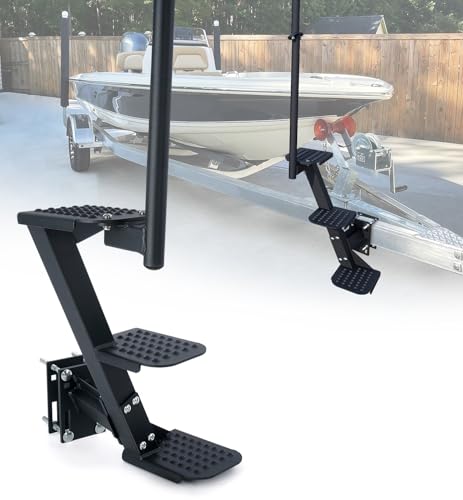
Best for: Pontoon trailers requiring a robust, universal 3-step solution with reliable anti-slip features. This Aupar model emphasizes a stable triangular support and secure handrail, suited for variable trailer tongues.
Why chosen: Its durable steel construction and corrosion resistance suit harsher marine environments, providing dependable boarding support across multiple pontoon setups.
Caution: Verify whether the three-step geometry aligns with your tongue height to ensure comfortable stepping distance.
Aupar Heavy Duty Boat Trailer Steps With Handrail

Best for: Boat owners needing a dedicated handrail on a heavy-duty 3-step design. The robust steel construction and anti-slip patches support safer boarding in varied weather conditions.
Why chosen: The model’s emphasis on slip-free boarding and a secure handrail makes it a strong pick for frequent access from the tongue to the deck, especially on larger pontoons.
Caution: The handrail length should be checked against your trailer setup to ensure comfortable reach without overextending users.
Eastrexon 4 Step Boat Trailer Steps

Best for: Pontoon setups that require a longer, 4-step sequence for easier access on taller trailers. The 3″–5″ universal fit accommodates many tongue sizes.
Why chosen: The four-step design with anti-slip mat and safety handrail provides a gradual ascent, reducing fatigue on frequent boarding. Suitable for larger pontoons with higher deck access.
Caution: Ensure the added step count does not intrude on the boat’s fender or dock line area during installation.
Buying Guide
- Compatibility: Check tongue size and frame width compatibility (commonly 3″–5″ wide). Look for universal or adjustable mounting options.
- Weight rating: Match the step’s weight capacity to the combined weight of boarding passengers and gear. Consider high-capacity models for family use or frequent boarding.
- Surface traction: Anti-slip surfaces are essential, especially in wet or muddy conditions. Verify tread texture and presence of non-slip pads.
- Handrail design: A secure, easy-to-grip handrail improves safety. Decide between fixed, left- or right-side mounting, or adjustable options to fit your boat edge.
- Material and finish: Powder-coated steel resists rust and corrosion; rust-proof finishes extend life in saltwater environments.
- Number of steps: Three steps suit shorter dock access; four steps offer gentler ascent for taller trailers. Consider your boarding frequency and height difference.
- Installation ease: Look for clearly labeled mounting points and included hardware. Some models require drilling or additional brackets for proper fit.
- Maintenance: Clean and inspect regularly for corrosion, loose bolts, and anti-slip wear. Recoat or replace parts as needed to maintain safety.
Frequently Asked Questions
- What is the typical load capacity for boat trailer steps?
– Most models range from 300 to 450 lbs, depending on construction and design. - Do I need to worry about rust on powder-coated steps?
– Powder coating provides significant rust resistance, but periodic inspection and cleaning help extend life in harsh marine environments. - Can I mount a three-step model on a variety of trailers?
– Yes, many are designed for universal tongue sizes, but verify mounting hardware compatibility with your trailer. - Are left- or right-handed rails better?
– It depends on boat orientation and docking area. Choose the side that avoids interference with deck hardware and provides comfortable access. - Is a four-step model better than a three-step one?
– A four-step model offers a gentler climb and more stepping surface, which can reduce fatigue on taller trailers or higher deck access.