Discover portable fish finders that work well on boats, kayaks, or shore launches. This guide highlights five strong options for American anglers seeking simple setups, reliable sonar, and easy transport. Each product is mapped to a typical buyer profile—whether you’re a weekend angler, a kayak enthusiast, or a boat captain needing quick deployment. Below is a concise buying table to compare core strengths at a glance.
| Product | Best For | Key Strength |
|---|---|---|
| Garmin Striker 4 Portable Kit | Weekend boaters; ease of use | Chirp sonar; portable kit |
| Humminbird Helix 5 G3 GPS | Serious anglers needing mapping | Dual Spectrum CHIRP; Basemap |
| Garmin Striker 4 with Transducer | Compact boats; simple setup | Clear Vu; multiple sizes |
| LUCKY Kayak Portable Fish Finder MT-202 | Kayak/personal craft | Wireless; long range |
| Venterior Portable Rechargeable Fish Finder | Castable or handheld use | Wireless probe; color display |
Garmin Striker 4 Portable Kit with 3.5″ Display

This portable fish finder pairs a compact 3.5-inch display with simple, button-led operation. It uses CHIRP sonar to deliver crisper arches and better target separation, helping you distinguish fish from structure. The Keyed interface supports fast setup and straightforward navigation, ideal for boaters who want reliable performance with minimal fuss. Best for casual boat trips where quick deployment matters and you need a clear view of underwater structure.
Use cases and limitations: Best for small to mid-size boats where space is at a premium. The device is easy to install and light to carry. The 3.5″ screen is sufficient for quick reads but may be small in bright sunlight on larger decks. Consider a larger display if you plan extended days on the water.
Humminbird Helix 5 G3 GPS with Transducer

This unit delivers Dual Spectrum CHIRP Sonar for broad and detailed searches, plus precise 2D target separation from a Low-Q transducer. Enhanced GPS navigation provides Basemap coverage for over 10,000 lakes and the U.S. coastline, with compatibility for premium LakeMaster, CoastMaster, and Navionics charts. Best for anglers who want deep mapping capabilities, robust sonar, and reliable GPS for backup and on-water planning.
Considerations: This model is more feature-rich and may be more complex to operate for absolute beginners. If you need a portable kit, confirm whether a carrying case is included or if an additional case purchase is necessary. It shines when you require advanced mapping and wide area coverage.
Garmin Striker 4 with Transducer, 3.5″ GPS Fishfinder

This Garmin Striker 4 model emphasizes a simple user experience with Clear Vu scanning sonar that provides near-photographic water imagery. Available in 3.5, 5, and 7-inch displays, it emphasizes ease of use, straightforward installation, and durability with IPX7 water resistance. It includes a waypoint map to easily view, mark, and navigate to locations like brush piles and docks. Best for boaters who want a compact, reliable option with solid sonar clarity and wall-to-wall versatility for shallow to moderate depths.
Limitations: While portable, the feature set is leaner than premium models; it may not provide the same charting breadth as higher-end units. Choose this if you prioritize simplicity and portability over advanced mapping features.
LUCKY Kayak Portable Fish Finder MT-202
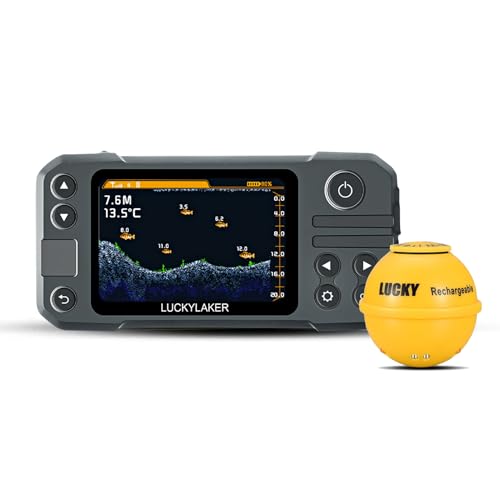
This wireless, castable system emphasizes freedom of movement. It features a long 853-foot operational distance between the sensor and handheld unit, making it strong for boats, kayaks, or shore fishing. It provides depth readings and the approximate location of fish relative to structures, along with a 3.5-inch display showing fish icons and depths. Best for anglers who want maximum portability and a long-range wireless setup. A potential drawback is that wireless systems can be sensitive to interference or water conditions, which may affect range consistency in rough waters.
Why this stands out: The wireless design reduces installation effort and hull penetrations, ideal for casual users who want quick setup and easy transport.
LUCKY Kayak Portable Fish Depth Finder Water Handheld

This handheld and pocket-friendly fish depth finder focuses on depth, fish location, bottom contours, and water temperature. It uses a castable transducer that you can attach to a boat or kayak hull to track depth changes while moving. Best for paddlers and small-boat operators who want a compact unit with a large, readable color display and an easy setup. A limitation is smaller screens can be harder to read at a distance or in bright sun; consider a model with a larger display if you need quick reads from afar.
Venterior Portable Rechargeable Fish Finder

This portable, rechargeable fish finder uses a wireless sonar sensor with a color display. It provides depth, water temperature, fish size, and bottom contour data, with a 105-degree sonar beam. Best for casual boaters and handheld use where quick, cast-to-cast reads are needed without wiring. It’s suitable for shore, kayak, or small boat setups. A note: wireless sensors can require occasional recalibration or sensor alignment for consistent readings.
Buying Guide
How to choose the right portable fish finder for a boat:
- Smaller screens are easier to mount on compact boats, but larger displays offer easier interpretation on the water.
- CHIRP sonar provides crisper images and better target separation. Dual Spectrum and scanning sonar are worth the extra cost if you fish in cluttered waters.
- If you fish unfamiliar areas, consider models with built-in maps or compatibility with premium map services.
- Portable kits with carry cases are convenient for renters or seasonal users. Wireless transducers minimize hull penetrations but may require careful placement.
- Check current draw and maximum depth ratings appropriate for your typical water depth and battery capacity.
- For saltwater or rough conditions, IP ratings and rugged housings help protect electronics.
FAQ
- What is the easiest portable fish finder to use on a boat? Models with a simple keyed interface and dedicated buttons, like Garmin Striker 4, are typically easiest for beginners.
- Do I need a radar-like chart on a portable unit? Not always. If you frequently navigate in unfamiliar waters, a unit with built-in maps or chart compatibility helps, such as Humminbird Helix 5 G3 GPS.
- Are wireless transducers reliable on moving boats? Wireless sensors offer portability, but ensure proper mounting and signal integrity; some conditions can affect range.
- Can I use these on a kayak? Yes. Several options, such as the LUCKY MT-202 and the handheld Venterior, are designed for kayaks and small craft.
- What depth range should I expect? Depth ratings vary; plan for your typical fishing depths. Some units handle shallow to moderate depths well, while others reach deeper freshwater or saltwater ranges.
- Is CHIRP sonar better than traditional sonar? Yes, CHIRP provides wider frequency sweeps for crisper arches and better target separation, especially in cluttered water.