You’re looking for reliable 12V trolling motor batteries that deliver deep cycles, lightweight handling, and solid safety features. This guide compares five top-rated options to help anglers and recreational boaters choose the best fit for their setups. Each product is evaluated for battery chemistry, cycle life, portability, safety features, and suitability for different boating styles—from casual shore fishing to extended off-grid boating trips.
Summary of selected products:
- ECO-WORTHY 12V 20Ah LiFePO4 — Lightweight, long cycle life, built-in BMS; best for compact setups and portable use.
- Newport Trolling Motor Smart Battery Box Power Center — External box with USB and DC ports; best for expanded accessory support.
- HumsiENK 12V 100Ah LiFePO4 — High capacity, long lifespan, expandable 12V system; best for larger boats or RV off-grid use.
- 12V 100Ah LiFePO4 Battery with Low-Temp Protection — Robust protection and temp tolerance; best for variable climates.
- DC HOUSE 12V 100Ah 3.0 Trolling Motor Battery — Integrated SOC indicators and smart charger; best for easy monitoring and all-around use.
ECO-WORTHY 12V 20Ah LiFePO4 Battery

Best for: Lightweight, portable setups and shorter trips where weight matters. The LiFePO4 chemistry delivers thousands of deep cycles, far surpassing lead-acid options. The 4.85-pound form factor makes it easy to transport and place in tight locations on small boats or canoes. A built-in BMS manages overcharge, over-discharge, and short circuits, ensuring safer operation. Caution: limited capacity means shorter trolling motor runtime per charge compared to higher-amp models.
Newport Trolling Motor Smart Battery Box Power Center with USB and DC Ports
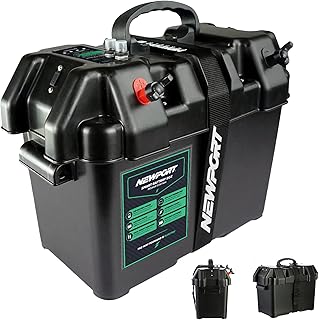
Best for: Boat owners who want an expanded power station with accessible USB and DC ports. The box features external battery ports and two integrated circuit breakers (10A and 60A) to guard trolling motors and accessories. A direct USB charger and a 12V accessory port add convenient charging options. Limitation: relies on the separate battery supplying the box; it does not specify included battery capacity, so pairing decisions are important.
HumsiENK 12V 100Ah LiFePO4 Battery

Best for: Larger boats or off-grid setups requiring extended life. This 100Ah pack emphasizes durability with up to 15,000 deep cycles and a robust BMS. The unit is relatively compact for its capacity and supports expansion in 12V systems up to higher voltages. It’s designed for RVs, marine uses, and camping power. Limitation: heavier than small-capacity packs, which may affect portability on smaller vessels.
12V 100Ah LiFePO4 Battery with Low-Temp Protection

Best for: Use in variable climates with strong temperature protection. The 100A BMS and IP67 rating aid protection against dust and water exposure. It’s engineered to manage charging safety across a wide temperature range, reducing risk in cold or hot environments. Limitation: some users may experience sleep-mode conditions during extended inactivity; activation might be required before use.
DC HOUSE 12V 100Ah 3.0 Trolling Motor Battery

Best for: Everyday trolling and outdoor use with easy monitoring. The 3.0 SOC status indicators provide real-time remaining power insight, while the built-in 100A BMS and a smart charger manage safety and longevity. The pack includes USB-A, USB-C, and DC ports for flexible device charging. Limitation: the product notes suggest occasional activation if the BMS has been triggered, so plan for reset steps in your setup.
Buying Guide
What should you consider when selecting a rechargeable trolling motor battery?
- : LiFePO4 (lithium iron phosphate) offers longer cycle life, lighter weight, and improved safety compared with lead-acid. If you fish or boat frequently, LiFePO4 is often the better long-term choice.
- : Higher amp-hour (Ah) ratings provide longer operation between charges. Match capacity to your trolling motor’s draw and expected trip duration.
- : Lighter packs ease handling on small boats or when you need to carry gear. Consider weight in relation to boat size and storage space.
- : A robust BMS protects against overcharge, over-discharge, short circuits, and thermal issues. Look for IP ratings if exposure to water and dust is likely.
- : Ensure the charger and BMS are compatible with your battery chemistry and desired charging speed. Some batteries include smart charging behavior or auto-restart features.
- : For larger setups, consider expandable systems that allow adding more modules or connecting to higher-voltage configurations (e.g., 24V or 48V) in the future.
- : Check dimensions and mounting options to fit in your boat’s battery tray or storage compartments.
FAQ
- What is the advantage of LiFePO4 over lead-acid for trolling motors? LiFePO4 provides longer cycle life, lighter weight, faster charging, and safer chemistry, reducing maintenance and weight on vessels.
- How many cycles can I expect from a LiFePO4 trolling motor battery? Typical LiFePO4 packs deliver thousands of deep cycles; specific numbers depend on usage, temperature, and charging methods.
- Is a BMS necessary for trolling motor batteries? A BMS helps protect cells from overcharge, over-discharge, and short circuits, extending battery life and safety on the water.
- Can I mix battery brands in a multi-battery setup? It’s best to use matched packs to ensure balanced charging and discharge. Inconsistent chemistry or capacity can reduce performance and lifespan.
- Do these batteries work in cold weather? LiFePO4 batteries typically tolerate cold better than some chemistries, but performance can still drop; low-temperature protection features help manage charging and usage.
- Do I need a special charger? Use a charger designed for LiFePO4 with appropriate current limits. Some packs include intelligent charging features or auto-restart behavior for safe operation.
These options provide a range of capacity, portability, and safety features designed to support different boating styles. When choosing, align the battery’s specs with your trolling motor draw, boat size, and typical trip conditions. The right battery can improve reliability, extend boating time, and simplify on-water charging and monitoring.