Answering the search for compact, electric propulsion, these small outboard motors suit anglers, kayakers, and casual boaters who want quiet, maintenance-friendly alternatives to gas engines. The top picks below highlight models ideal for saltwater or freshwater use, portability, and dependable run times. If you need a lightweight setup for a kayak or small craft, choose these five options based on thrust, range, and control features.
Newport NT300 Electric Outboard Motor

The Newport NT300 delivers 3HP-equivalent power (1300 watts) with about 110 lb of thrust, designed for saltwater and freshwater use. It features a digital throttle with an LCD display, a 24.6″ shaft, and a 9.8″ two-blade composite propeller. Trim/tilt positions (0°, 7°, 14°, 21° / 70°) and field-oriented control support smooth handling in varying water conditions. Best for boats that need quiet, emissions-free propulsion with extended range on a single charge. Limitations include runtime affected by boat weight and conditions.
- Top speed: around 6.5 MPH
- Single-charge range: up to 66 miles
- Maximum runtime: up to 30 hours
Best for: anglers and small boaters who want quiet, long-running electric propulsion with straightforward digital controls. Choose this if you need robust range without sacrificing performance.
Newport NV-Series 55lb Thrust Saltwater Trolling Motor

This 12V electric trolling motor provides 55 lb of thrust with a 30″ shaft and a 6″ telescoping tiller. It includes a 3-blade propeller and a 5-LED battery meter. Speed is delivered through 8 settings (5 forward, 3 reverse). The top speed varies with boat characteristics, but the design emphasizes low noise and endurance for all-day use. A limitation is that real-world runtime depends heavily on battery capacity and vessel weight.
- Notable feature: adjustable mount height and direction
- Best for: mid-sized boats requiring reliable saltwater performance with straightforward battery indicators
Minn Kota Endura C2 Transom-Mount 30 Lb – Freshwater
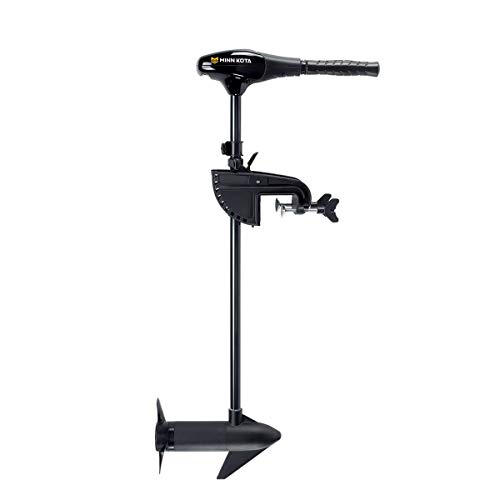
Designed for freshwater use, the Endura C2 offers a 30 lb thrust, a 30″ shaft, and a 6″ telescoping tiller for comfortable control. It includes a push-to-test battery meter and a 10-position lever lock bracket for easy angle adjustments. The reinforced composite construction resists flexing, warping, and UV damage, making it durable for regular fishing trips. A potential limitation is that higher-thrust needs may require stepping up to models with more power.
- Best for: anglers who fish smaller lakes or rivers and want simple, reliable control
- Better for: lightweight, easy-to-maneuver setups in calm waters
Newport NV-Series 36lb Thrust Trolling Motor
This trolling motor provides 36 lb of thrust in saltwater and freshwater environments, designed for kayaks, canoes, inflatables, and small boats. It emphasizes lightweight power and battery efficiency with a two-blade propeller. It suits lighter setups where mobility matters most. A caveat is that it might not deliver enough thrust for larger vessels or current-heavy conditions.
- Best for: paddling boats and small crafts that require quiet, portable power
- Choose this if: you prioritize portability and battery efficiency over maximum thrust
Newport NV-Series 62lb Thrust Trolling Motor
Built for larger boats and heavier loads, the 62 lb thrust trolling motor is designed for tougher conditions and longer runs. It features a robust saltwater-capable build and a large 3-blade propeller for stronger thrust and improved handling. Best for jon boats or mid-size craft that demand higher power in windy or current-filled waters. Caution: heavier unit, may require more battery power and mounting space.
- Best for: bigger boats and challenging water conditions
- Better for: higher-thrust needs when stability matters most
Buying Guide: How To Choose The Right Small Electric Outboard
Key questions to consider guide your choice for small electric outboard motors. Matching thrust, weight, battery capacity, and mounting compatibility ensures reliable performance on days out on the water.
- What boat size and weight will the motor need to move efficiently?
- Is saltwater resistance important? Look for corrosion-resistant materials and seals.
- Do you need long runtime or quick charging? Consider battery capacity and charging options.
- Which shaft length fits your transom height and boat depth?
- How important is quiet operation and minimal maintenance?
To compare effectively, group options by use case: kayak or small craft (lower thrust, high portability), freshwater fishing boats (balanced thrust and control), and larger dinghies or jon boats (higher thrust for sustained performance). Durability in marine environments, ease of installation, and control features like digital throttles or LCD indicators can influence daily use and long-term reliability.
Product Comparison Snapshot
| Product | Thrust | Best For | Notes |
|---|---|---|---|
| Newport NT300 | 110 lb thrust | All-around, long-range cruising | 66-mile range, 30-hour runtime |
| Newport NV-Series 55lb | 55 lb | Saltwater trolling, all-day use | LED battery meter |
| Minn Kota Endura C2 30 lb | 30 lb | Freshwater, lightweight setups | Telescoping tiller |
| Newport NV-Series 36 lb | 36 lb | Kayaks, small crafts | Portable and efficient |
| Newport NV-Series 62 lb | 62 lb | Larger boats, tougher conditions | High thrust for stability |
FAQ
- What electric outboard is best for a kayak?
Answer: A lightweight model with moderate thrust (like 36 lb) that balances weight and battery life is ideal for kayaks. - Do electric outboards perform well in saltwater?
Answer: Yes, many models use corrosion-resistant materials and seals designed for saltwater or mixed environments. - How long does a typical electric outboard run on a charge?
Answer: Runtime depends on battery capacity, motor power, and boat load; some options offer up to several hours under favorable conditions. - Is higher thrust always better?
Answer: Not always. Higher thrust suits larger boats or heavier loads, but it can reduce efficiency on light craft. - What should I consider for mounting and shaft length?
Answer: Ensure shaft length matches transom height and that mounting hardware fits your boat’s transom profile.