When choosing a smart boat battery charger, look for models that protect against overcharge, offer temperature compensation, and support multiple battery chemistries. This guide highlights five top options that are well-suited for marine applications, including lead-acid and lithium systems. The buyers best served are boat owners needing reliable on-board charging, maintenance, and desulfation capabilities in varying climates.
The following quick-reference table compares the five selected chargers for boats. All are designed to handle 6V/12V systems where applicable or multiple banks, with temperature compensation and automatic maintenance modes.
| Product | Bank/Output | Best For | Notes |
|---|---|---|---|
| NOCO GENIUS1 | 1 Bank, 1A | Small boats, single battery setups, maintenance | Compact, multi-chemistry support |
| NOCO GEN5X2 | 2 Banks, 10A total (5A per bank) | Multi-bank boats, larger marine systems | Waterproof, advanced modes |
| NOCO GENIUS10 | 1 Bank? (10A) | Higher current needs, larger batteries | More power, compact design |
| NOCO GEN2D | 1 Bank, 2A | Onboard maintainer, direct-mount installs | Direct-mount design for tight spaces |
| NOCO GENIUS5 | 1 Bank, 5A | Compact upgrade for mid-size boats | Balanced power and size |
NOCO Genius1: 1A 6V/12V Smart Charger

Best for: Boat owners with a single battery or compact power needs. Why selected: The GENIUS1 is a compact, all-in-one charging solution that functions as a charger, maintainer, trickle charger, and desulfator. It supports lead-acid variants and LiFePO4, with an integrated thermal sensor that adjusts charging to ambient temperature, reducing overcharge in heat and undercharge in cold.
Key features enable precision charging for 6V and 12V systems across several battery types, including flooded, maintenance-free, and AGM chemistry. A notable limitation is its single-bank 1A output, which may be slower for larger batteries or in boats with multiple batteries that require concurrent charging.
Best use cases include small sailboats, dinghies, or personal watercraft where a low-amp maintenance cycle is sufficient. The GENIUS1’s smaller footprint is advantageous for tight engine compartments or limited space near the battery bay.
NOCO Genius GEN5X2: 2-Bank, 10A Onboard Charger
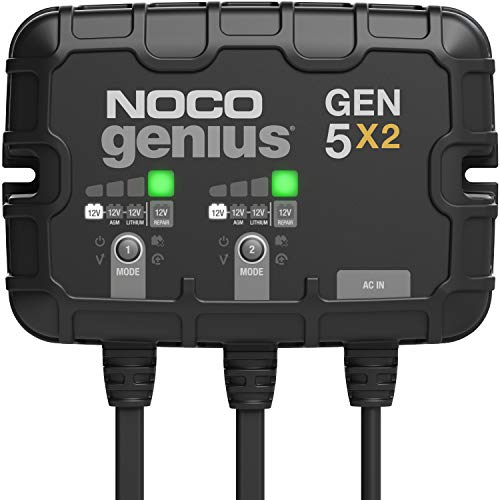
Best for: Boats with two batteries or two separate circuits needing simultaneous charging. Why selected: The GEN5X2 provides 10 amps total across two banks, making it suitable for mid-sized boats that demand quicker replenishment or simultaneous charging of engine and house batteries. Independent bank charging allows tailored modes for each battery type.
It features selectable modes per bank, including 12V, 12V AGM, 12V Lithium, and a repair mode, enabling precise conditioning of different chemistries. Temperature compensation helps maintain safe, efficient charging in marine environments. A potential limitation is its higher price and larger footprint versus single-bank models, which may matter on smaller vessels.
Choose this if you operate a boat with multiple critical batteries or routinely run accessories that draw significant current. It’s a strong option for maintaining motors, trolling batteries, or house systems without sacrificing space.
NEXPEAK NC201 10-Amp Battery Charger

Best for: Boat owners who want a versatile, automatic maintainer with temperature compensation and desulfation. Why selected: The NC201 delivers 10 amps across 12V and 24V options, making it versatile for boats using different systems. It emphasizes safety with multiple protections and a desulfation function designed to extend battery life.
Notable limits include a caveat around charging dead or deeply discharged batteries; while it supports sulfation repair, batteries at 0V may require longer recovery. The model’s 7-stage design provides fast charging without compromising longevity, when used within the recommended battery type range.
Use this model when you need robust maintenance across a variety of 12V and 24V boat batteries, including hybrids and deep-cycle options. It can simplify keeping idle batteries in good condition during extended storage.
NOCO GENIUS10: 10A 6V/12V Smart Charger
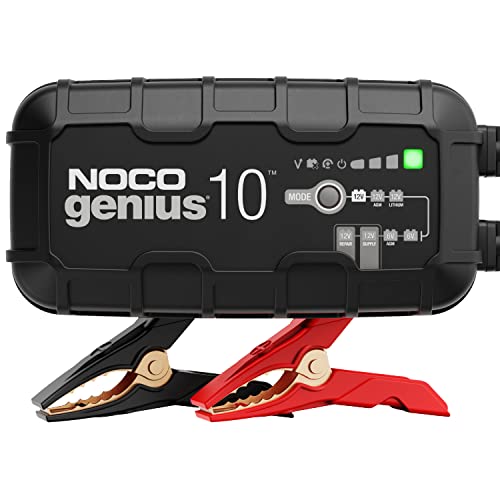
Best for: Boats needing higher recharging power in a compact package. Why selected: The GENIUS10 offers a substantial power boost over smaller models while remaining compact. It supports 6V and 12V systems across lead-acid and LiFePO4 chemistries and includes thermal regulation to protect battery health in varied climates.
Its higher amperage makes it suitable for larger house batteries or engines with heavier start requirements. A limitation is that it is not a multi-bank unit, so if you require independent charging for multiple batteries, you may prefer a two-bank option.
NOCO GENIUS2D: 2A Onboard Battery Charger
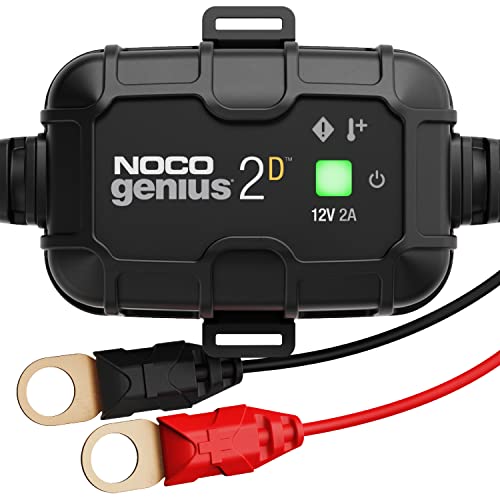
Best for: Boats seeking a direct-mount, onboard maintenance solution. Why selected: The GENIUS2D is designed to mount near the battery, delivering a compact, integrated charging setup. It focuses on 12V lead-acid batteries and is easy to install in tight spaces. The direct-mount design reduces clutter and can simplify wiring in engine rooms or lockers.
Limitations include a lower 2A output compared with mainline models, which may not suit high-current cruising setups or large deep-cycle bank maintenance. Best for maintenance-focused installations rather than high-demand charging sessions.
NOCO GENIUS5: 5A 6V/12V Smart Charger

Best for: Boats that need a higher-amperage single-bank charger with compact size. Why selected: The GENIUS5 sits between smaller and larger options, delivering a balanced 5A output suitable for mid-size boats and house batteries without taking up too much space. It maintains the same intelligent features—temperature compensation, desulfation, and overcharge protection.
Better for owners who want a capable maintenance charger without stepping up to a multi-bank configuration. A potential drawback is that it does not inherently provide two independent banks for separate battery systems.
Buying Guide: Key Considerations For Marine Battery Chargers
What battery chemistry do you use? Most marine chargers support lead-acid variants (AGM, Gel, flooded) and LiFePO4. Confirm compatibility with your boat’s batteries before purchase.
How many banks do you need? A single-bank charger suits smaller boats, while two-bank or multi-bank models are better for boats with separate engine and house batteries or multiple starting batteries.
What is the charging current you require? Higher amperage charges faster but may be less practical in compact engine rooms. Choose a model whose output aligns with your battery capacity and boat electrical load.
Is temperature compensation important? Temperature-sensing charging helps prevent overcharging in heat and undercharging in cold, extending battery life in varying marine climates.
Do you need onboard mounting? Direct-mount units simplify installation in tight spaces but may require more planning around battery positioning and access for maintenance.
What about protection features? Look for overcharge protection, reverse polarity protection, short-circuit safeguards, and desulfation capabilities to maximize battery longevity and reliability on the water.
FAQ
- Q: Can I use a marine charger with a 24V boat system? A: Some models support 24V configurations (e.g., 12V systems with multiple banks or specialized 24V modes). Check product specs to ensure compatibility with your boat’s voltage.
- Q: Do these chargers require professional installation? A: Most can be installed by a knowledgeable DIYer, but if wiring near the hull or battery compartments is involved, consider professional assistance for safety and compliance.
- Q: Will temperature compensation harm my battery in extreme cold? A: No. Temperature compensation adjusts charging to ambient conditions, helping avoid thermal stress and extending battery life when used properly.
- Q: Is desulfation beneficial for all marine batteries? A: Desulfation helps some lead-acid batteries by mitigating sulfation; lithium systems typically do not require this process.
- Q: Can I maintain multiple battery banks with a single charger? A: This depends on the model. Two-bank or multi-bank chargers are designed for independent charging of multiple battery banks.
- Q: Are there any safety concerns with boating electronics? A: Use marine-rated chargers, ensure proper insulation and ventilation, and follow the manufacturer’s mounting and wiring guidelines.