In the market for a solar powered battery charger for a boat? This guide highlights five reliable 12V solar trickle chargers with MPPT or smart controllers, designed to keep marine batteries topped up without overcharging. Best for: boat owners with infrequent use of vessels, seasonal trailers, or those who want a low-maintenance charging solution. Below you’ll find quick product snapshots, then detailed sections to help you compare features, protections, and suitable battery chemistries at a glance.
| Product | Best For | Key Benefit | Notes |
|---|---|---|---|
| POWOXI 7.5W | Small boats, personal watercraft | Smart protection and high efficiency | Compact, easy install |
| Voltset 20W | RVs, boats, trailers | MPPT for faster charging | Universal 12V compatibility |
| ECO-WORTHY 10W | Budget setups, long-term storage | Simple, reliable trickle charging | Weatherproof, open circuit testing |
| SOLPERK 20W | Marine and automotive use | Smart controller with high efficiency | Durable build for harsh conditions |
| Sun Energise 25W | Boats, RVs, larger battery banks | High efficiency MPPT | Smart three-stage charging |
POWOXI Upgraded 7.5W Solar Battery Trickle Charger
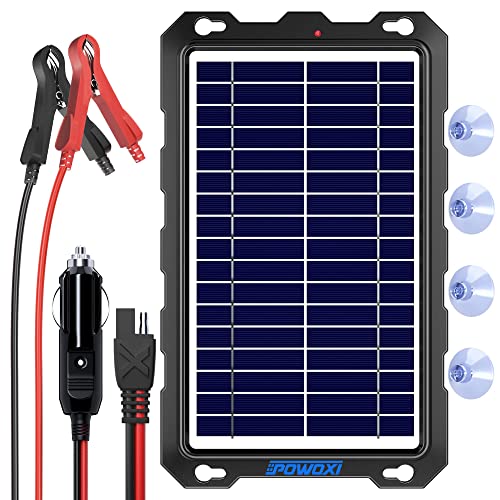
The POWOXI charger includes an intelligent charge controller that works with high-efficiency solar silicon, targeting 25-30% energy conversion. It features a built-in protection system to prevent overcharge and short circuits, making it safer to use with marine batteries. The 7.5W unit is built for durability with high-transparency glass that withstands wind and snow. Best for: small boats, personal watercraft, and portable setups where space or weight is a concern. Limitations: the lower wattage means slower charging in low sun or when the battery is deeply discharged.
Voltset 12V Solar Battery Charger – 20W

Voltset offers a 20W solar panel with an MPPT controller, designed to deliver 20-30% faster charging for 12V batteries. It is compatible with LiFePO4, AGM, Gel, Flooded, and Lithium-Ion chemistries, making it a versatile choice for boats, RVs, and trailers. Best for: boat owners seeking quicker recharge times and broad battery compatibility. Caution: MPPT unit may be overkill for very small sun exposures or minimal battery capacity.
ECO-WORTHY 10W Solar Car Battery Charger Maintainer
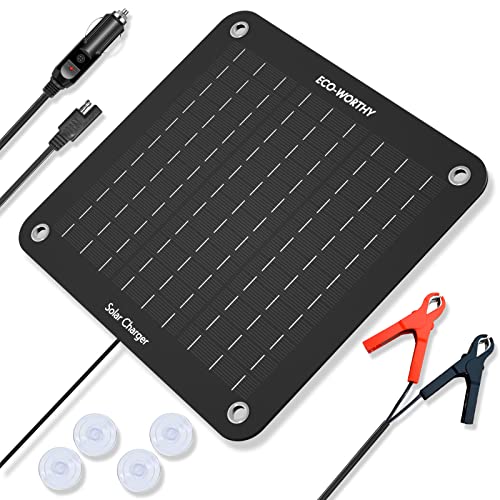
ECO-WORTHY’s 10W panel is built for durability and safety. It uses a trickle charging approach with a blocking diode to prevent reverse charging and supports operation in cloudy conditions. It’s waterproof and designed for outdoor use, making it well-suited for boats in marina storage or seasonal use. Best for: budget-conscious boaters needing reliable maintenance with straightforward setup. Limitation: 10W may be modest for larger battery banks or extended storage without auxiliary charging.
SOLPERK Solar Panel Kit 20W with MPPT Controller
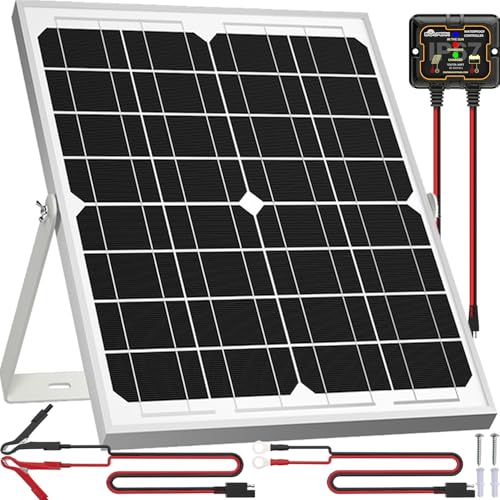
SOLPERK provides a 20W solar kit with monocrystalline A+ cells and a smart controller offering up to 20-30% higher charging efficiency than traditional controllers. It’s designed to charge and maintain a variety of 12V batteries and handles harsh weather thanks to a robust frame and waterproof construction. Best for: larger boats or vehicles with higher energy needs and a requirement for reliable maintenance. Caution: ensure mounting and cable routing protect the controller from direct splash in high-spray environments.
Sun Energise 25W 12V Solar Battery Charger

Sun Energise combines a higher wattage with built-in MPPT, delivering up to 99% tracking efficiency and peak conversion around 98%. The three-stage charging algorithm (Bulk, Absorption, Float) provides safer charging and helps extend battery life. Best for: boats with larger 12V battery banks or where faster replenishment is needed after long storage. Limitation: higher wattage requires more mounting space and a sturdier mounting setup than smaller panels.
Buying Guide
What should I look for in a marine solar charger?
- Wattage and sunlight: Higher wattage charges faster, but requires more panel area and sturdy mounting.
- Controller type: MPPT controllers optimize energy capture, especially in variable light; PWM is simpler and cheaper.
- Battery compatibility: Ensure compatibility with LiFePO4, AGM, Gel, and flooded batteries depending on your boat’s setup.
- Weather resistance: Look for waterproof, corrosion-resistant builds and tempered glass for durability in marine environments.
- Overcharge protection: A reliable blocking diode or smart controller prevents damage during long storage.
Mounting and installation considerations
- Placement: Aim for maximum sun exposure with minimal shade; consider tilt and angle to optimize capture.
- Wiring: Use weatherproof connectors; route cables away from hot engine compartments and sources of abrasion.
- Storage and maintenance: Choose models with low-maintenance designs and simple diagnostics (LED indicators).
Battery chemistry and longevity
- LEAD-ACID vs. LITHIUM: Lithium batteries tolerate deeper discharges but require appropriate charging (MPPT often recommended).
- Charging stages: Three-stage charging helps prevent overcharging and extends cycle life.
- Seasonal use: For boats stored for long periods, a trickle charger that auto-resumes when voltage drops is ideal.
Usage scenarios
- Occasional use boats: Smaller panels (7.5W–10W) with smart protection work well.
- Seasonal storage or larger vessels: Higher wattage (20W–25W) with MPPT provides faster, safer upkeep.
- Mobile or trailer setups: Flexible kits with easy mounting and cigarette lighter compatibility are convenient.
FAQ
- Q: Do I need an MPPT controller for my boat solar charger? A: MPPT controllers improve energy capture, especially under cloud cover or partial shade, but they are more expensive. For small systems, PWM may suffice.
- Q: Will a 25W panel overcharge my boat battery? A: No, if you use a charger with proper regulation and automatic cut-off, the system will stop charging when the battery reaches full capacity.
- Q: Can these chargers work in cloudy weather? A: Yes, many panels maintain charging at reduced rates; MPPT models typically perform better under diffuse light.
- Q: Are these chargers waterproof? A: Most are designed for outdoor, marine use with weatherproof enclosures; check IP ratings and mounting guidelines.
- Q: What battery types do these work with? A: Common 12V chemistries include AGM, Gel, Flooded, LiFePO4, and Lithium-Ion, but verify compatibility with the specific controller.
- Q: How do I know when my battery is fully charged? A: Look for built-in indicators (LEDs) on the controller or panel; many units stop charging automatically at full voltage.