If you’re searching for a dependable solar solution for a boat, these five options provide sturdy charging for 12V systems, long lifespans, and marine-ready design. They’re suitable for boaters who want trickle charging, battery maintenance, or off-grid power while staying within a compact, corrosion-resistant footprint. The top picks cover solar panels, MPPT controllers, and deep-cycle lithium options to suit varying needs—from weekend minnows to longer voyages.
Overview at a glance: the table below summarizes the five products selected for boaters. It highlights best-use cases, key strengths, and any simple caveats to consider when choosing a marine solar setup.
| Product | Best For | Key Strength | Limitation |
|---|---|---|---|
| SOLPERK Solar Panel Kit 20W 12V | Compact boats, small battery maintenance | Smart MPPT controller, high efficiency | Limited wattage for larger systems |
| Voltset 12V Solar Battery Charger – 20W | Versatile 12V charging for multiple vessels | Fast charging with MPPT, broad battery compatibility | 20W may be small for high-demand boats |
| Renogy 200W Panel Kit 12V | Medium to larger boats, expandable power | Expandable up to 400W, PWM controller | PWM not as efficient as MPPT in low sun |
| 12.8V 100Ah LiFePO4 Battery (HRBEENERGY) | Long off-grid trips, deep cycle needs | Long cycle life, built-in BMS | Battery costs higher upfront |
| ECO-WORTHY 260W Kit | Off-grid boats needing substantial daily power | Flexible 2x130W panels, higher daily output | Flexible panels require proper mounting |
SOLPERK Solar Panel Kit 20W 12V
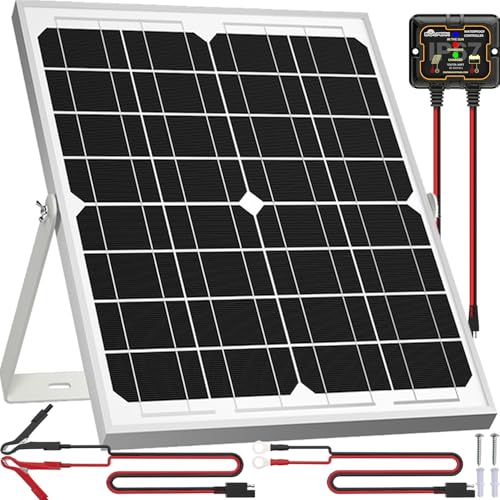
Best for small boats or as a maintenance charger on larger vessels. This kit uses a monocrystalline A+ cell with 21%-30% efficiency and includes an 8A smart MPPT controller. It is designed to charge a variety of 12V batteries including LiFePO4, AGM, and GEL. The mounting hardware and waterproof construction support marine environments. The controller provides three-stage charging and shows status indicators so you can monitor progress on the go.
Who it’s best for: boaters with limited space who want reliable trickle charging and a compact, weatherproof option. Why selected: it pairs a high-efficiency panel with a capable MPPT controller to maximize charging in marine conditions. Caution: the system’s 20W output is best for smaller battery banks or auxiliary charging rather than heavy daily power needs.
Voltset 12V Solar Battery Charger – 20W

Best for boaters seeking a versatile, universal 12V charger for cars, RVs, boats, and trailers. The Voltset kit uses an advanced MPPT controller to deliver 20-30% faster charging for a broad battery lineup, including LiFePO4, AGM, Gel, and flooded types. Built-in protections guard against overcharge and short circuits, and the controller stops draining power at night.
Who it’s best for: those who want a single, flexible charger across several vessels or trailers. Why selected: the kit emphasizes universal battery compatibility and smart protection. Caution: its 20W output may be low for high-demand boat systems, so pairing with larger banks or multiple panels may be necessary.
Renogy 200W Solar Panel Kit 12V

Best for boats needing scalable solar power with a straightforward upgrade path. The Renogy kit includes two 100W panels, easy mounting hardware, and a Wanderer PWM controller. It supports expansion by adding more panels up to 400W and can connect with battery and inverter options for a more complete marine power system. The module’s 25% cell efficiency helps deliver consistent performance in varied sun.
Who it’s best for: saltwater skippers planning to extend system capacity over time. Why selected: its complete mounting-friendly design and expansion potential make it a practical backbone for medium to larger boats. Caution: PWM control is less efficient than MPPT at optimizing charging in shaded or variable light conditions.
12.8V 100Ah LiFePO4 Deep Cycle Battery

Best for long off-grid trips and deeper cycling needs on boats. This LiFePO4 battery features an internal 100A BMS and IP67-rated waterproof case for wet environments. It provides up to 8000+ deep cycles and an energy capacity around 1280Wh, making it a robust replacement for traditional AGM or lead-acid options. It’s a strong choice when reliability and longevity are priorities on the water.
Who it’s best for: boaters who demand a long-life, maintenance-light power storage solution. Why selected: the built-in BMS and waterproof design align well with marine use. Caution: upfront costs are higher than standard lead-acid batteries, though lifetime cost can be lower with extensive cycling.
ECO-WORTHY 260W Solar Panel Kit

Best for boats that require substantial daily power and a flexible mounting setup. This kit includes two 130W mono panels, a 30A 12V charger controller, and cables. It’s designed to increase daily energy production and is described as being lighter than traditional glass panels, aiding transportation and installation on boats with uneven surfaces. The kit supports off-grid living aboard and extended cruising.
Who it’s best for: long-range sailors or campers on a boat looking for higher daily output. Why selected: dual 130W panels offer solid daily energy, plus practical mounting options. Caution: flexible panels may require careful, secure mounting to withstand boat motion and vibration.
Buying Guide: What To Consider Before Buying Marine Solar
What battery type matches your needs? Lithium (LiFePO4) offers longer life and lighter weight but can cost more upfront. AGM or flooded lead-acid options are cheaper but heavier and need more maintenance. If you plan long trips, LiFePO4 can pay off over time.
How much power do you actually need? For small boats with little electrical demand, 20W panels paired with a capable MPPT can suffice. Larger boats or those with refrigeration, water pumps, and lights may require 100W–400W or more, plus a scalable controller and battery bank.
Which controller is right? MPPT controllers extract more power in variable sun and are generally preferable on boats where shading and angles vary. PWM controllers can be more affordable but are less efficient in fluctuating conditions.
Is mounting important? Marine setups require corrosion-resistant hardware, waterproof enclosures, and secure mounting. Flexible panels can be lighter and easier to fit on curved surfaces but must be firmly secured to resist movement.
What about expansion? If future power needs may grow, choose a kit that allows additional panels or a larger battery bank. This avoids multiple upgrades and ensures you can scale as your boating needs change.
What maintenance is needed? Most marine solar systems are low-maintenance, but regular checks of connections, fuses, and mounting integrity help prevent failures. A simple status indicator on the controller can keep you informed about charging health.
FAQ
- What size solar panel is best for a small boat? A compact 20W–100W panel with MPPT is a good starting point for small boats or auxiliary charging; larger vessels typically require more wattage.
- Do I need a deep-cycle battery for boating? A deep-cycle battery, especially LiFePO4, is designed for repeated charging and discharging, making it suitable for marine use and longer trips.
- Is MPPT worth it for boating? Yes. MPPT controllers optimize power harvest in fluctuating sun conditions, leading to faster charging and better battery health on boats.
- Can solar panels withstand marine environments? Look for panels with corrosion-resistant frames, waterproof constructions, and proper sealing to handle spray and salt exposure.
- Can I expand my solar system later? Choose kits that support additional panels and compatible controllers; this helps you scale without replacing existing hardware.
- Do solar panels work in cloudy conditions? They still generate power, though at reduced efficiency. A larger battery bank can help smooth out intermittent solar input.