Discover the best spud poles and shallow-water anchors for boats, designed to keep your craft secure in varied conditions. This guide highlights five top picks and explains who each product is best for, plus practical considerations to help you choose. Whether you’re bass fishing, cruising calm bays, or anchoring near beaches, these poles offer different strengths in materials, grip, and ease of use.
| Product | Best For | Key Feature |
|---|---|---|
| SuperStick Shallow Water Anchor Pin, 3/4″ x 8′ | Lightweight boats in calm to moderate waters | Stainless spike tip for durability |
| Pelican Anchor and Push Pole – Shallow Water Anchor Pin | Grab-and-go usability for quick setups | Ergonomic handle and integrated rope routing |
| EDSRDPLT 2006 7.75′ Anchor and Push Pole | Compact, buoyant two-piece design for storage | Embedded compass and T-handle for navigation |
| itayak 8.63′ Shallow Water Anchor Pole | Longer reach with strong fiberglass construction | 316 stainless tip; two-piece, screw-lock |
| Island Anchor – 1″ x 8′ | Larger boats in tougher conditions | Turbo-Tip with grooved helix for hard bottoms |
SuperStick Shallow Water Anchor Pin, 3/4” x 8′, Black
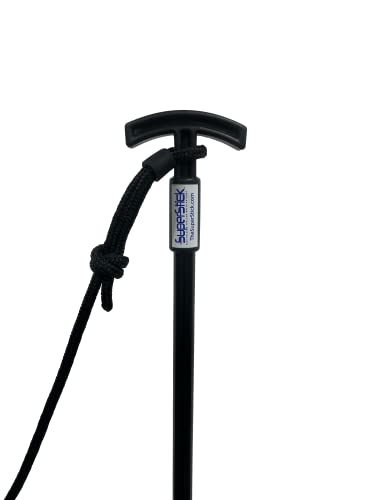
The SuperStick 3/4” x 8′ anchor pin features a stainless steel ultra-durable spike tip to resist tip wear and splintering, enabling easier anchoring in shallow waters. Best for smaller boats or calm-water setups where a light, durable spike contributes to quick, consistent holds. A single, robust spike helps minimize drag and keeps the pole easy to insert. A potential limitation is that the fixed diameter may be less versatile in uneven bottoms compared with telescoping designs.
Pelican Anchor and Push Pole – Shallow Water Anchor Pin
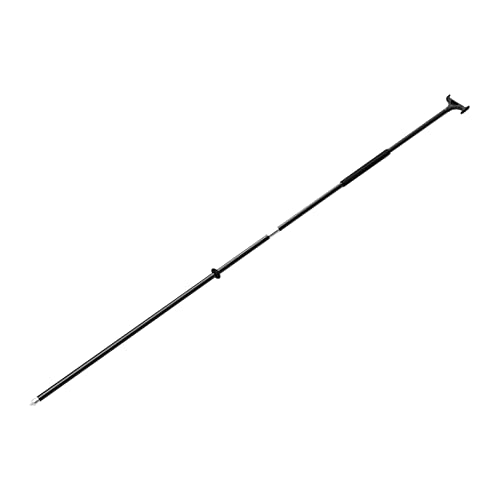
The Pelican pin includes an ergonomic foam-lined handle with an integrated hook, useful as a push pole. Its two-piece fiberglass shaft features a rubber ring to prevent rope slipping, making it a practical option for quick, controlled anchoring in shallow water. Best for anglers who want a comfortable grip and straightforward setup. A limitation is that two-piece joints may require occasional tightening to maintain stability in rough conditions.
EDSRDPLT 2006 7.75′ Anchor and Push Pole

This buoyant two-piece design floats and stores easily, with a T-handle and integrated compass to assist basic navigation. The pole uses reinforced nylon, engineering-grade fiberglass, and aviation-grade aluminum, with a 316 stainless steel tip for corrosion resistance. Best for boaters who need a floatable option with navigation aids. Caution: the assembly includes multiple materials, so ensure proper care to prevent joint loosening over time.
itayak 8.63′ Shallow Water Anchor Pole

Itayak offers an 8.63′ pole with a two-piece design, a T-handle, and a 316 stainless tip. It emphasizes strong corrosion resistance and a secure screw-lock connection to reduce detachment risk. Best for boats needing a longer reach and solid construction. Limitation: cutting or damaging the pole may release glass fibers, so gloves are recommended during handling.
Island Anchor – 1″ x 8′

The Island Anchor Pole is designed for larger boats and harsher conditions, featuring a Turbo-Tip with a sharp, grooved helix for easy penetration in sand or clay. The 1″ diameter and 8′ length provide substantial reach and durability, powered by strong aircraft-grade fiberglass. Best for heavy-use scenarios where reliability matters. A potential drawback is its size, which may be less convenient for compact storage.
Buying Guide
What should you consider when choosing a shallow-water anchor pole?
- Pole material: Look for fiberglass-reinforced plastics for a balance of strength and weight, with stainless steel tips for corrosion resistance in saltwater.
- Length and reach: Longer poles offer deeper penetration in deeper water but may be heavier; shorter ones are easier to store.
- Joint construction: Screw-lock joints tend to be more secure than quick-connects, but may require occasional tightening.
- Handle comfort: An ergonomic, non-slip handle reduces fatigue during extended use.
- Buoyancy: Some poles float, which helps in retrieval and storage, especially on open water.
- Intended use: Consider boat size, bottom type (sand, mud, clay), and typical water depth to match the pole’s strength and tip design.
FAQ
- Q: Which pole is best for saltwater use? A: Poles with 316 stainless steel tips and corrosion-resistant fiberglass or polymers are preferred for saltwater environments.
- Q: Is a longer pole always better? A: Not necessarily. Longer poles provide deeper reach but are heavier and harder to store—balance with boat size and storage space.
- Q: Do poles require maintenance? A: Yes. Rinse after saltwater use, check joints for looseness, and tighten or replace fasteners as needed.
- Q: Should I choose a two-piece or fixed-length pole? A: Two-piece poles offer storage flexibility, while fixed-length poles are simpler and often sturdier for rugged use.
- Q: What bottom type affects performance most? A: Hard-packed sand or clay with a sharp tip (Turbo-Tip) penetrates better; softer bottoms may rely more on grip features and bottom-friendly tips.
- Q: Is a built-in compass useful? A: It can help with basic navigation in calm conditions, but it should not distract from safe boating practices.