If you need quick, reliable battery readings for trolling motors and other 12V systems, use a purpose-built battery tester. These devices help determine state of charge, voltage, and health, so you can plan charging or replacement. This guide highlights five top testers ideal for boaters, RVers, and outdoor enthusiasts who rely on 12V and higher-voltage battery setups.
| Product | Best For | Why It Stands Out |
|---|---|---|
| Minn Kota MK-BM-1D Digital Battery Meter | 12V trolling motors and boats | Simple LED readout and SOC indicators for quick checks |
| SUNAPEX Digital Battery Voltage Tester | Multiple voltage systems (6V-48V) | Wide range, clear LCD, fast results |
| Mislezy 12V Battery Meter | 12V lead-acid setups | Five-segment SOC display with auto-sleep for energy savings |
| KONNWEI KW208 | Comprehensive 12V testing | Balanced features, extensive testing for cranking/charging |
| ANCEL BA101 Car Battery Tester | Automotive and marine 12V systems | SOH, SOC, voltage, CCA, and system tests |
Minn Kota MK-BM-1D Digital Battery Meter

The Minn Kota MK-BM-1D is a compact 12-volt battery monitor designed for power management on boats with trolling motors or other 12V systems. Useful for anglers and boat owners who need straightforward voltage checks and state-of-charge (SOC) indicators. It displays current voltage on an LED readout and uses simple SOC states for quick interpretation.
Best for: Boat owners who want a dedicated 12V readout with clear SOC status at a glance. It’s a lightweight, plug-and-play option that minimizes setup time.
Limitation: It focuses on 12V monitoring and may not cover higher-voltage configurations without a separate tester.
SUNAPEX Digital Battery Voltage Tester

The SUNAPEX tester covers 6V to 48V, making it versatile for cars, boats, RVs, golf carts, and off-grid solar batteries. It features a bright 4-character LCD display for quick voltage readings and a simple clip-on setup (positive to red, negative to black) for fast checks. It’s ideal for users who need a single tool across multiple battery systems.
Best for: Users with mixed 12V and higher-voltage setups who want a single, easy-to-read tester with broad compatibility.
Limitation: LCD readings depend on ambient lighting; direct sunlight may necessitate shading for optimal visibility.
Mislezy 12V Battery Meter

The Mislezy 12V Battery Meter provides a five-segment LED indicator to show 10%–100% charge and includes reverse polarity protection for safe wiring. It’s designed for lead-acid 12V storage batteries and offers an auto-sleep feature after 30 seconds of inactivity to conserve power.
Best for: Enthusiasts who want a simple, energy-saving indicator with built-in protection to reduce installation errors.
Limitation: Limited to 12V lead-acid systems; not ideal for high-voltage or non-lead-acid chemistries without alternative tools.
Automotive Authority Marine Trolling Battery Indicator
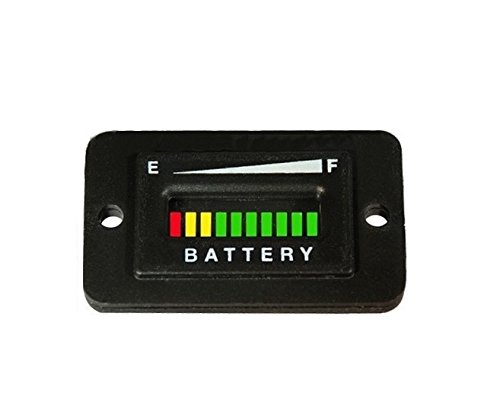
This 12V–24V indicator is designed for battery-powered equipment, including trolling motors. It emphasizes monitoring the charge status to prevent unexpected power loss during boating or other marine activities. It’s straightforward for installation with included instructions.
Best for: Marine and outdoor setups where consistent charge visibility matters for 12V to 24V systems.
Limitation: May not provide detailed SOH/SOC metrics beyond basic charge status; rely on it for basic awareness rather than precise capacity readings.
ANCEL BA101 Car Battery Tester

The ANCEL BA101 is a versatile automotive battery tester that measures State of Health (SOH), State of Charge (SOC), voltage, current, and CCA. It supports multiple battery types and temperature-based readings for more accurate results. It’s a robust option for vehicles, boats, and RVs, with a straightforward interface and quick feedback.
Best for: Users who want a multi-parameter tester that covers health, charge, and cranking performance across various battery types.
Limitation: Displays more data than casual users may need; requires correct input of battery type, rating, and temperature for best accuracy.
Buying Guide
What should I look for in a trolling motor battery tester?
Key considerations include voltage range, battery type support, and readability. If you own multiple platforms (boats, cars, RVs), a tester with a wide voltage range (e.g., 6V–48V) offers flexibility. For trolling motors specifically, prioritize 12V monitoring with clear SOC indicators and quick readings.
What should I use for 12V vs. higher-voltage systems?
Use 12V-specific meters for simple boats and trolling setups. For fleets or mixed hardware, a wide-range tester like SUNAPEX or KONNWEI KW208 provides a single tool for diverse systems, reducing the need to purchase multiple devices.
Is safety a concern with battery testers?
Yes. Choose testers with protective features such as reverse polarity protection and rugged clamps. Ensure proper connection: red to positive, black to negative, and secure all clips before testing to avoid short circuits or sparks.
How do I read results quickly?
Look for devices that display voltage and state of charge in simple formats. Models with LED indicators or a concise LCD readout allow fast interpretation in dim or bright lighting conditions, which is common on boats and RVs.
What about handheld vs. inline devices?
Handheld testers are portable for quick checks in the field. Inline meters stay connected to the battery for ongoing monitoring. Choose based on how often you test and whether you need real-time status or periodic checks.
FAQ
- Q: Do I need a battery tester for a trolling motor? A: A tester helps monitor voltage and charge status, reducing the risk of motor stalls due to low battery.
- Q: Can I test multiple battery types with one device? A: Some testers support 6V–48V and various chemistries; check product specs before use.
- Q: How often should I test my batteries? A: Regular checks before trips and monthly during usage cycles help maintain reliability.
- Q: What indicates a failing battery? A: Consistently low remaining capacity, rapid voltage drop under load, or inaccurate readings are signs to test further or replace.
- Q: Are these testers safe to use around marine environments? A: Most testers are designed for general use, but follow manufacturer guidelines and keep devices dry and away from moisture.