Answer: A trolling motor terminal block should provide durable, corrosion-resistant connections that handle the right amperage and voltage, while keeping wiring neat and safe. This guide highlights five top options for boats and marine setups. Best for compact, straightforward layouts are single-stud blocks; better for higher power are dual-stud or multi-stud designs. The selections below cover a range of stud sizes, amp ratings, and insulation styles to suit most 12V marine systems and small to mid-size trolling motors.
| Product | Stud Size | Max Amps | Voltage Range | Best For |
|---|---|---|---|---|
| RECOIL S1P-38 Busbar | 3/8″ | 250A | 48V DC | Compact, high-current single-stud blocks |
| RED WOLF 12V 100A | 1/4″ (M6) | 100A | 12-48V DC | Typical 12V systems with multiple connections |
| Joinfworld 12V 250A 4x 5/16″ | 5/16″ (M8) | 250A | 12-48V DC | Higher versatility with multiple posts |
| RECOIL S2PG Busbar | 5/16″ | 150A DC | 48V DC | Two-way distribution with divider |
| RED WOLF 12V 150A | 5/16″ (M8) | 150A | 12-48V DC | Balanced high-current, dual-stud layout |
Note: The listed specs are based on the manufacturers’ feature descriptions. Choose blocks with appropriate stud size, current rating, and insulation to match your trolling motor’ s wiring gauge and environmental exposure. Ensure a snug terminal connection to prevent voltage drop and heat buildup during long runs.
RECOIL S1P-38 Busbar: Compact 3/8″ Studs

The RECOIL S1P-38 is a single-connection busbar with 3/8″ 304 stainless steel studs and included 8AWG 3/8″ ring terminals. A reinforced polycarbonate cover, fastened with nylon nuts, guards against accidental short circuits. It is rated up to 48V DC and 250A continuous, making it suitable for moderate trolling motor systems or as a primary distribution point in a compact setup. Best for boaters needing a straightforward, shielded power block with solid corrosion resistance.
Who it’s best for: small to midsize trolling motors or auxiliary battery banks where a single heavy-duty post is the primary power distribution point. Better for: simple, low-profile installations where space is limited. Caution: ensure compatibility with thicker wires or larger terminals you might add later, as the single stud limits expansion.
RED WOLF 12V 100A Dual Stud Block

This 12V distribution block uses a 1/4″ (M6) dual stud design, allowing larger terminal connectors and wires. It supports up to 100A (MAX) in a 12-48V DC system. The assembly features 316 stainless steel nuts with copper studs for corrosion resistance and good conductivity, plus a flame-retardant nylon base for insulation and safety. It offers a tidy solution to join multiple battery connections and reduce short-circuit risk. Best for: mid-range trolling motors or solar setups requiring two main connections with robust construction.
Who it’s best for: boat owners needing a compact dual-stud option capable of clean, organized wiring. Caution: continuous current may drop with high temperature or humidity, so verify operating conditions in hot environments.
Joinfworld 12V 250A 4x 5/16″ Block

The Joinfworld block features four 5/16″ posts plus a positive/negative pair, designed for 12V systems up to 250A. It supports wiring across a wide range and emphasizes a robust, insulated nylon base. Best for: users needing multiple large connections in a marine, automotive, or solar wiring setup, with emphasis on high-current distribution. Choose this if you need more posts and a sturdy, fixed layout. Caution: ensure your wiring gauge matches all four posts and that mounting is secure to avoid loosening under vibration.
Joinfworld 12V 250A With 4 x 5/16″ Studs, Thick Copper Bus Bar

This block upgrades to a thicker copper bus bar plate for broader compatibility with larger cables. It includes red and black (positive and negative) distribution blocks rated up to 250A in a 12V circuit and supports up to 48V. It uses 4 x 5/16″ studs and 3 x #8 screws, with a nylon base for insulation and fixed mounting. Best for: demanding marine wiring where high current and a tidier layout are priorities. Caution: check that the thicker copper plate fits within your terminal compartment and that mounting hardware won’t interfere with nearby components.
RECOIL S2PG 2-in-1 Busbar with Divider

This dual-stud block uses two 5/16″ stainless studs and a built-in divider to separate positive and negative connections. It includes 2 x 4AWG and 2 x 8AWG ring terminals, plus stainless screws. The reinforced polycarbonate cover protects against short circuits, with a max rating of 48V DC and 150A DC. Best for: installations needing a two-pole distribution at moderate current. Choose this if you want a compact, clearly separated positive/negative layout. Limitation: dual-stud design may still require careful wire management for larger gauges.
RED WOLF 12V 150A Dual Stud Block
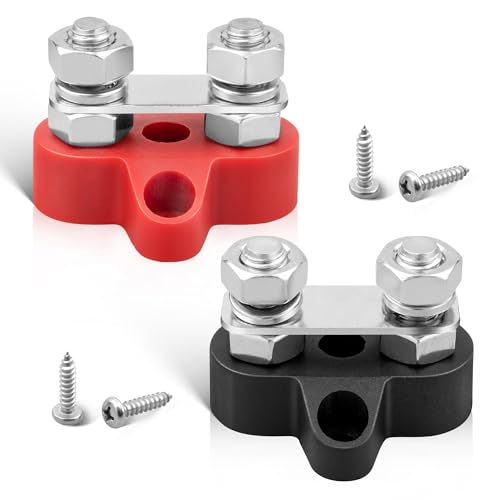
Featuring dual 5/16″ studs (M8) for large terminal connections, this block supports up to 150A in 12-48V DC systems. It uses copper studs and 316 stainless steel nuts for corrosion resistance, plus a flame-retardant nylon base. Best for: mid-to-high current marine or automotive applications requiring robust, dual-post distribution. Avoid this if you only need a single connection and a smaller footprint.
Buying Guide
What to consider when choosing a trolling motor terminal block
Power rating: Match the amp rating to your trolling motor’s current draw and future expansion. Higher currents require sturdier studs and larger gauges.
Stud size and count: Larger studs support thicker wires but may limit compact installations. Dual-stud and multi-stud designs offer greater wiring flexibility.
Material and corrosion resistance: Stainless steel hardware and copper conductors improve longevity in saltwater environments.
Insulation and safety: A reinforced cover or nylon base reduces accidental shorts and protects connections from moisture.
Mounting and space: Consider the available space on your boat using a block with an appropriate footprint and a secure mounting method.
Maintenance: Look for designs that allow easy inspection of terminals and wires, with simple tightening mechanisms to prevent loosening under vibration.
How to install a trolling motor terminal block
1) Plan wire routes to minimize length and avoid chafing. 2) Disconnect power and remove terminals from the battery. 3) Drill suitable mounting holes and secure the block with hardware. 4) Strip wire ends to proper length, attach ring terminals or lugs, and tighten to recommended torque. 5) Verify polarity and test for continuity before operation. 6) Apply a sealant or cover if exposed to harsh marine conditions.
Comparison at a glance
- Most compact: RECOIL S1P-38, best for single high-current posts in tight spaces.
- Best value for dual connections: RED WOLF 12V 100A and RED WOLF 150A blocks.
- Most versatile in multi-wire setups: Joinfworld 4x 5/16″ block for up to 250A.
- Best standalone two-pole design: RECOIL S2PG with divider for positive and negative separation.
Frequently Asked Questions
- What is a trolling motor terminal block used for?
It serves as a central hub to distribute power from the battery to the trolling motor and other accessories while keeping connections organized and protected. - What voltage should I look for in marine blocks?
Most trolling motor systems use 12V or 24V, but blocks can handle up to 48V in some models. - Is dual-stud better than a single stud?
Yes, dual or multi-stud designs provide more connection points and reduce crowding on a single post, beneficial for larger wiring or multiple accessories. - Are stainless steel nuts enough for corrosion resistance?
They help, but copper or brass conductors and proper insulation also matter for longevity in saltwater environments. - How do I choose the right size for my wire?
Refer to the wire gauge and the terminal lug size. Larger wires require larger studs and lugs to prevent overheating.