Answering the needs of boaters who require reliable DSC-capable VHF radios, this guide highlights five solid options. Each model is chosen for clear DSC features, emergency signaling, and practical use at sea. Ideal buyers include coastal crews, anglers, coastal cruisers, and recreational sailors seeking enhanced safety and straightforward navigation communications. The table below compares key details to help you choose quickly.
| Product | DSC / GPS / AIS | Waterproof Rating | Best For | Note |
|---|---|---|---|---|
| Uniden UM385 | DSC, Triple Watch | IPX4 | Casual to mid-range boats needing all-in-one weather alerts | USA/International/Canadian channels |
| Retevis RM40 | DSC, GPS, MOB alarm | IP67 | Offshore and coastal navigators needing precise location sharing | Floating handheld |
| ICOM M94D | DSC, AIS receiver | IPX8 | Coastal cruisers needing AIS visibility | Long battery life |
| Uniden UM725GBT | DSC, GPS, Bluetooth | IPX8 | Tech-savvy crews wanting smart device integration | Built-in GPS, NOAA alerts |
| Uniden UM725 | DSC, NOAA alerts | IPX8 | All-around safety with broad channel coverage | Large LCD screen |
Uniden UM385 25W Fixed Mount Marine VHF Radio
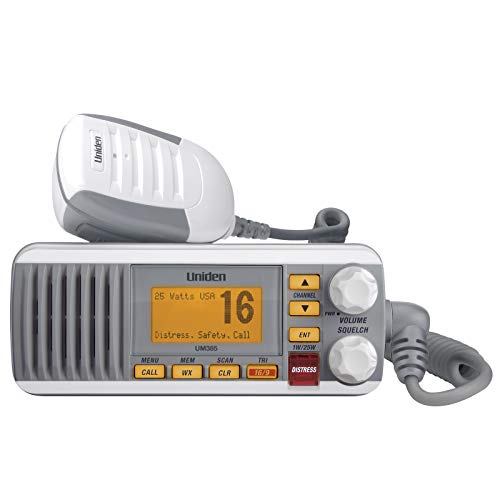
The UM385 offers 25-watt output with DSC, Triple Watch, and S.A.M.E. Weather Alert. It supports a wide range of international channels and is designed for easy operation from the helm, making it a solid pick for captains who want quick access to emergency DSC signaling and weather updates. Best for boaters who need reliable all-weather monitoring and straightforward channel access.
Why chosen: DSC capability plus weather alerts and international channels cover common offshore needs. Caution: IPX4 rating is less protective than IPX8 options, so handle in harsher conditions with care.
Retevis RM40 Marine Radio With GPS

The RM40 combines GPS-equipped DSC with MOB and distress calls. Its IP67 waterproof rating and floating design make it ideal for offshore fishing, kayaking, and coastal cruising where quick location sharing is critical. Best for watermen and small craft crews who need real-time position updates and reliable emergency signaling.
Why chosen: Automatic GPS transmission improves rescue times. Caution: As a handheld unit, battery life and weatherproofing should be considered for all-day operations on longer trips.
Icom M94D 21 USA VHF Marine Transceiver

The M94D includes built-in AIS and DSC, providing vessel traffic information and faster distress calls. It delivers 6 W transmit power and long battery life via a 2400 mAh Li-ion battery, along with a clear 1500 mW audio output for noisy marinas. Best for boaters who value AIS visibility and strong audio while cruising near busy waterways.
Why chosen: AIS receiver enhances situational awareness. Caution: Higher feature set can imply a steeper learning curve for new users.
Uniden UM725GBT Marine VHF Radio

The UM725GBT stacks GPS, Bluetooth, and DSC on a robust IPX8 platform. It supports NMEA0183/2000 data for GPS and DSC, and NOAA weather channels with alerts. Best for tech-friendly crews who want seamless integration with smartphones and other onboard devices.
Why chosen: Bluetooth and GPS integration boost modern boating workflows. Caution: As a feature-rich unit, setup may require more time to unlock all capabilities.
Uniden UM725 Marine VHF Radio

The UM725 provides IPX8 waterproofing, NOAA weather alerts, DSC distress calls, and a large LCD display. It covers all U.S., Canadian, and international channels at 1 or 25 watts, with a boat-friendly text messaging capability. Best for crews prioritizing weather updates and reliable long-range communication.
Why chosen: Wide channel coverage with distress capabilities. Caution: Some users may prefer integrated GPS for immediate location sharing, which UM725GBT offers in a separate model.
Buying Guide: Key Purchase Considerations
What features matter most for DSC safety on a VHF radio? Look for built-in DSC distress calling, GPS location sharing, and AIS visibility where available. A robust weather alert system helps prepare for changing conditions on open water.
How should you choose between fixed-mount and handheld radios? Fixed-mount units are reliable on larger boats and when you want quick helm access. Handheld models excel for small crafts, emergency kits, and portability, but may require spare batteries and careful charging routines.
Which rating matters most for seaworthiness? IPX8 ratings indicate submersibility and are preferable for harsh marine environments, while IPX4 or IPX7 offer solid protection for many coastal trips but less overall ruggedness.
What about integration with devices? If you want Bluetooth, GPS, or data sharing with smartphone apps or onboard navigation, choose models explicitly supporting those features (for example UM725GBT). Consider NMEA compatibility if you rely on GPS and data connections with other gear.
How to assess DSC capability? Ensure the radio supports DSC distress calls, individual calls, and priority channels. For offshore use, a radio with automatic GPS location broadcasting can dramatically improve rescue times.
Frequently Asked Questions
- What does DSC do on a marine radio? It enables digital distress signaling and private calls, improving emergency response efficiency.
- Is AIS included on most VHF radios? Some models, like the ICOM M94D, include AIS receivers to show nearby vessel traffic on compatible displays.
- Do handheld radios float? Many handhelds are IP67/IP68 and floating; check the specific model’s waterproof and floatation specs.
- How important is NOAA weather alert? Very helpful for storm tracking and safety planning; consider radios with S.A.M.E. weather alerts for certain regions.
- Can I connect a VHF radio to a smartphone? Some models offer Bluetooth or data interfaces; ensure your chosen unit supports the desired connectivity and apps.
- What is the difference between 1W and 25W transmit power? Higher wattage extends range but may require stronger antennas and power management on smaller vessels.