The top picks below are the best VHF radios for boats, chosen for reliability, marine-channel access, and ease of use. This guide targets boaters needing clear, dependable communication on saltwater or freshwater vessels. Best for crewed boats, small powerboats, and coastal anglers who want NOAA weather alerts and DSC features. A quick reference table summarizes the five highlighted models and their standout specs.
| Product | Watts | Waterproof | Best For |
|---|---|---|---|
| Uniden UM385 | 25 | IPX4 | All-around reliability, handheld/compact installs |
| Uniden UM385BK | 25 | IPX4 | Budget-friendly all-USA/Intl channels, weather alerts |
| Cobra BlueBound 350 (Black) | 6 | IPX7 | Floating, rugged handheld with long-range potential |
| Cobra BlueBound 350 (White) | 6 | IPX7 | Floating, high-visibility option for crews |
| Uniden UM725 | 1/25 | IPX8 | Largest in-class LCD, NOAA weather with alerts, GPS |
Uniden UM385 25W Fixed Mount Marine VHF Radio
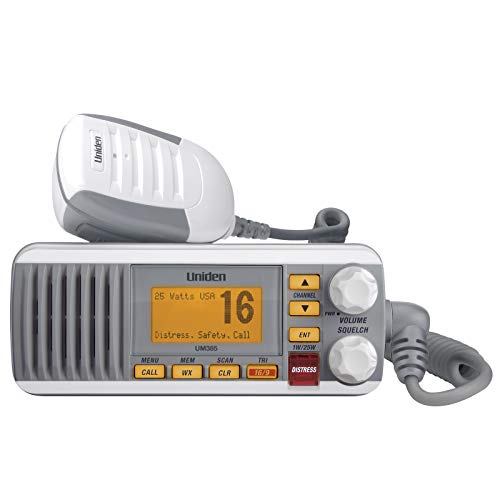
The UM385 integrates triple watch, DSC capabilities, and S.A.M.E. Weather Alert in a compact fixed-mount design. It covers international marine channels, making it suitable for boats sailing in diverse waters. The fixed-mount mic helps operators transmit without taking their eyes off the water. Best for boats needing a robust, mid-range fixed radio with weather alerts and DSC features.
Who it’s best for: coastal skippers and small crewed boats that want a single, all-in-one radio with emergency features and weather updates. Limitation: IPX4 water resistance is adequate but not submersible, so avoid full immersion scenarios.
Uniden UM385BK 25W Fixed Mount Marine VHF Radio

Similar to the UM385, the UM385BK adds the same weather alert and channel range in a black housing. It’s a compact fixed-mount option that emphasizes weather warnings and DSC, suitable for budget-minded crews who still want comprehensive marine communication. Best for boats that favor a darker console look and straightforward setup.
Who it’s best for: budget-conscious operators who want international channels and weather alerts in a fixed-mount unit. Caution: IPX4 rating means the radio isn’t designed for submersion; avoid harsh spray exposure.
Cobra BlueBound 350 VHF Handheld Marine Radio – Black

This 6-watt handheld offers a floating design with IPX7 waterproofing and USB-C charging. It features a high-visibility display and an orange floating core for quick retrieval. Best for small boats or as a backup radio where portable use and floatation matter. Caution: as a handheld unit, range can be more limited than fixed-mount systems in open waters.
Who it’s best for: boaters needing a rugged, floating handheld to carry on deck or in a tender. Choose this if you value portability and quick access in case of a man-overboard scenario.
Cobra BlueBound 350 VHF Handheld Marine Radio – White

The White version shares the same floating design, 6-watt output, and IPX7 waterproof rating with the Black variant. It offers the same day/night LCD readability and power-switching options. Best for crews who prefer a bright, visible unit for deck use or manual signaling. Caution: as with all handhelds, weather conditions can affect signal clarity and reach.
Who it’s best for: crews needing a bright, easy-to-read handheld with reliable floatation. Choose this if you want high visibility in poor lighting conditions and a matching color option for gear coordination.
Uniden UM725 Marine VHF Radio

The UM725 delivers IPX8 submersible waterproofing, a large LCD, NOAA weather channels with alerts, DSC distress handling, and a built-in speaker microphone. It supports 1W/25W transmit power and covers all U.S., Canada, and international channels. Best for boaters who prioritize weather alerts and advanced safety features from a high-end fixed-mount unit. Limitation: the model emphasizes GPS and Bluetooth features that may be outside basic needs for some users.
Buying Guide
What’s the right VHF radio power for your boat?
Standard marine VHF radios offer 1 watt to 25 watts transmit power. Higher wattage improves range in open water or when obstacles block the signal. Choose 25-watt models for larger boats or longer coastal voyages; opt for 6-watt handhelds for decks or small vessels near shore.
Fixed-mount vs. handheld: which should you pick?
Fixed-mount radios provide stable performance, easier antenna integration, and power efficiency. Handhelds offer portability, emergency backups, and safer retrieval if dropped overboard. For many boats, a fixed unit paired with a handheld as a backup is a strong configuration.
What features matter most?
- NOAA Weather Alerts: essential for storm tracking and safety.
- DSC (Digital Select Calling): enables distress signaling and position sharing.
- GPS Built-in: aids in precise location sharing during emergencies.
- Waterproof rating: IPX8 or IPX7 indicates submersion protection; IPX4 covers splash resistance.
- Channel availability: ensure international, USA, and Canada channels if you sail beyond domestic waters.
Durability and ease of use
Look for rugged construction, clear displays, and simple interfaces. Floating handhelds reduce loss risk if dropped. Large, high-contrast displays improve readability in bright sun or rough seas.
Integration with other systems
Some radios offer Bluetooth, NMEA input/output, or SMS/text messaging capabilities. These can streamline data sharing with navigation equipment and onboard devices but may require additional setup and compatibility considerations.
Safety considerations
Always verify the radio’s compliance with local maritime regulations and ensure you have a functioning antenna, redundant power sources, and a backup unit on board for emergencies.
FAQ
- What is the difference between fixed-mount and handheld VHF radios? Fixed-mount radios stay installed on the vessel and typically provide stable performance; handhelds offer portability and can be used as backups.
- Do I need DSC on a boat VHF radio? DSC enables distress signaling and automatic location sharing, which can improve response times in emergencies.
- Are waterproof ratings important for boats? Yes. Submersible ratings like IPX7/IPX8 protect against rain, spray, and immersion in rough seas.
- How many channels should I consider? Look for models offering USA, Canada, and international channels if you travel internationally or near coastal borders.
- Is NOAA weather alert important? Yes. It provides timely warnings about storms and weather hazards at sea.
- Can I connect a VHF radio to other navigation gear? Many radios support NMEA or Bluetooth for GPS and data integration; check compatibility before buying.