Finding a VHF radio with AIS transponder helps boaters monitor nearby traffic while staying in touch with shore and other vessels. This guide highlights five reliable options and explains who each is best for. If you navigate busy waters, choose a model that combines AIS receive or transmit with robust VHF features, built-in GPS, and durable build for marine use.
Product Comparison Snapshot
| Product | Key Benefit | Best For |
|---|---|---|
| STANDARD HORIZON Fixed Mount VHF/GPS/AIS/NMEA2000 | NMEA2000 with AIS and internal GPS | Boat owners needing networked hull-to-network navigation |
| Icom M94D 21 USA VHF Marine Transceiver with DSC & AIS Receiver | Integrated AIS, DSC safety, long battery life | Active coastal/counting on AIS calls and distress alerts |
| Garmin 0100209800 VHF 215 AIS | AIS integration with Garmin ecosystem | Garmin-heavy setups seeking visual AIS integration |
| Lowrance VHF Marine Radio, DSC, AIS-RX, LINK-9 | DSC and AIS receive with LINK-9 | Lowrance display users needing DSC/AIS compatibility |
| ICOM M424G 21 Fixed Mount VHF Radio with Internal GPS | Internal GPS, AIS transponder compatible | Compact option with essential AIS/GPS features |
STANDARD HORIZON Fixed Mount VHF/GPS/AIS/NMEA2000

Features: Reliable fixed-mount VHF with NMEA2000, AIS, and internal GPS. The setup is designed for boaters who want AIS visibility alongside standard VHF communications, with network-ready NMEA2000 compatibility for data sharing among instruments.
Best for: Mariners seeking a unified, networked radio that easily shares AIS data with other NMEA2000 devices. Its AIS capability helps track traffic and enhances collision avoidance in busy waters.
Caution: Data-sharing compatibility depends on other NMEA2000 devices on board. Ensure your existing instruments are NMEA2000-enabled for full cross-communication.
Icom M94D 21 USA VHF Marine Transceiver with DSC & AIS Receiver

Features: Built-in AIS receiver for nearby vessel traffic, integrated DSC safety calls, 6W transmit power, long-lasting 2400 mAh Li-ion battery providing up to 10 hours of operation, and a loud 1500 mW audio output for clear calls in noisy marinas or engines rooms.
Best for: Small to mid-sized boats needing strong AIS awareness and reliable DSC capability. The long battery life supports all-day offshore or coastal voyages.
Caution: Battery life can vary with transmission duty cycle and screen usage; plan charging routines for extended trips.
Garmin 0100209800 VHF 215 AIS

Features: AIS-enabled VHF with slate-gray body and accent color. This model integrates with Garmin’s ecosystem, offering straightforward AIS information alongside standard VHF functionalities.
Best for: Garmin-centric pilots who want cohesive on-panel AIS viewing and easy data sharing within a Garmin-heavy cockpit. Better for users already invested in Garmin navigational displays.
Caution: May be less flexible with non-Garmin instruments; verify compatibility with current gear before purchase.
Lowrance VHF Marine Radio, DSC, AIS-RX, LINK-9

Features: VHF marine radio with DSC, AIS receive, LINK-9 compatibility. Model number LOW00014472001 and two-channel capability highlight its dual-channel operation in some configurations.
Best for: Anglers or coastal cruisers using Lowrance displays who want integrated DSC and AIS-RX alongside familiar LINK-9 connectivity for emergency communications.
Caution: Availability and firmware updates may depend on Lowrance ecosystems; confirm support for your existing chartplotter setup.
ICOM M424G 21 Fixed Mount VHF Radio with Internal GPS

Features: MA-500tr AIS transponder compatibility, Aqua Quake draining function, IPX7 submersible protection (1M depth for 30 minutes). Built for deep-water use with reliable GPS integration and water-resilient design.
Best for: Boats requiring a compact fixed-mount solution with solid GPS and transit capability in wet environments. Suitable for offshore or near-shore sailing where spray or splashes are common.
Caution: Ensure AIS transponder compatibility is specifically required for your setup; verify integration with existing AIS networks before purchase.
Cobra MR F77W GPS Fixed Mount VHF Marine Radio
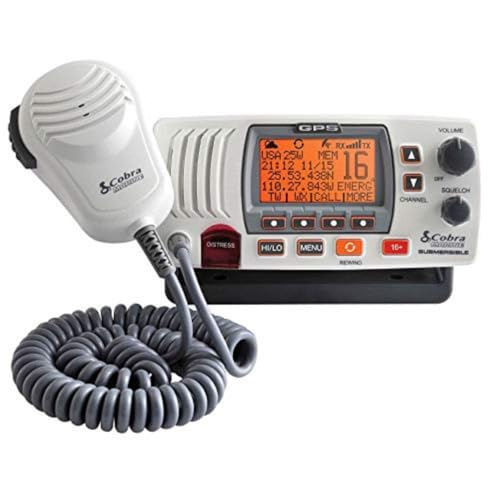
Features: Built-in GPS receiver to quickly determine location for distress signals, 1 or 25 watts power output for short and long-range communications, NOAA weather features, and a replay function that records the last 20 seconds of transmission for missed calls.
Best for: Recreational boaters who value immediate location awareness during emergencies and need a straightforward, user-friendly interface with weather features.
Caution: The 25-watt option is dependent on regulatory rules; users should confirm transmission power settings align with local requirements and channel use guidelines.
Buying Guide: Key Purchase Considerations
- AIS integration: Decide whether you need AIS-RX (receive) or AIS transponder (transmit and receive). AIS improves collision avoidance and traffic awareness on busy waterways.
- DSC compatibility: If distress calls or individual calls are critical, choose models with built-in DSC features for rapid signaling.
- GPS and internal antennas: Internal GPS helps speed distress transmissions and location tagging; consider external GPS options if you require broader satellite acquisition.
- NMEA2000 and instrument networking: For boaters with multiple displays and sensors, NMEA2000 compatibility ensures data sharing across devices.
- Durability and water protection: Look for IPX7 or higher ratings if you boat in rough weather or salty environments.
- Battery life and power options: For handhelds or portable configurations, consider battery capacity and charging cycles; fixed-mount models rely on vessel power.
- Brand ecosystem: If you use Garmin or Lowrance displays, compatibility with those ecosystems can streamline operation and data visibility.
- Channel and power settings: Confirm available channels (U.S./Canada/International) and adjustable power (1W, 6W, 25W) to balance range and battery use.
Frequently Asked Questions
- What is AIS and why do I need it with my VHF radio?
AIS provides automatic vessel identification and traffic information. When paired with a VHF radio, it enhances situational awareness and helps prevent collisions in busy waters.
- Should I prioritize DSC or AIS first?
DSC is essential for emergencies and private calls; AIS is key for traffic awareness. If you operate in crowded lanes, both are valuable—choose a model with both capabilities.
- Are fixed-mount VHF radios better than handhelds?
Fixed-mount units typically offer higher transmit power, more features, and greater durability for regular use on a vessel, while handhelds provide portability for temporary or emergency use.
- What is the advantage of NMEA2000 networking?
NMEA2000 allows data sharing between instruments—GPS, radar, and displays—creating a cohesive navigation system on board.
- How important is GPS in a VHF with AIS?
Internal GPS speeds distress signaling and helps locate you during calls. External GPS may be preferable if you require redundancy or rugged reception in challenging conditions.
- Can I mix brands for AIS and VHF?
In many cases, yes, but verify compatibility with your existing chartplotters and displays to ensure reliable data transfer and display actually works as intended.